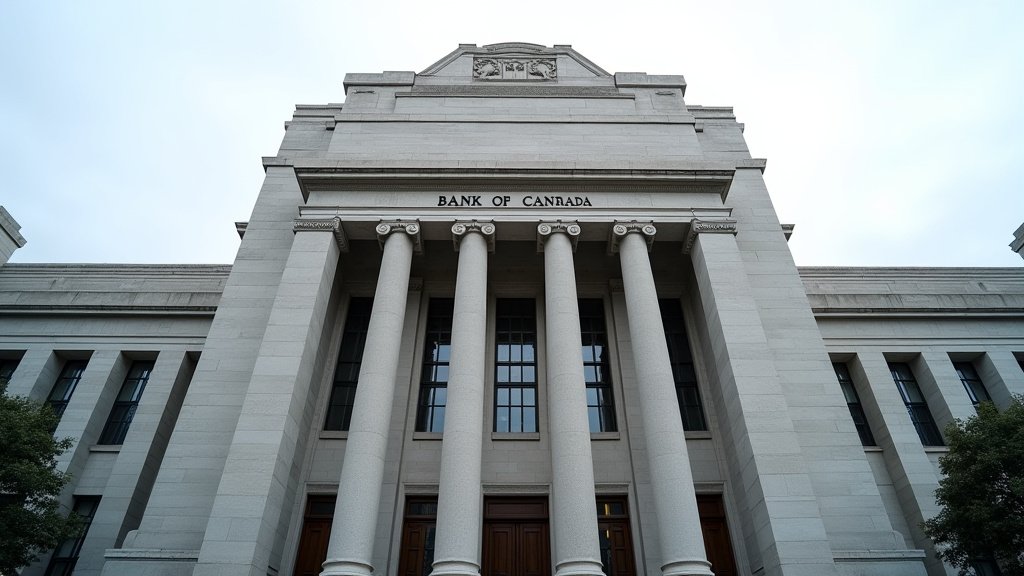
BoC Holds Steady: Policy Rate Fixed at 2.25% Amid Economic Stability
In a widely anticipated announcement that underscores a commitment to economic calibration, the Bank of Canada officially confirmed today that it will maintain the policy interest rate at 2.25%. This decision, delivered by the Governing Council, reflects the central bank’s ongoing efforts to balance inflation targets with the broader health of the Canadian economy. Market analysts and stakeholders were watching closely for this determination, which serves as a critical benchmark for borrowing costs across the nation.
Key Highlights
- Rate Hold: The policy interest rate remains unchanged at 2.25%.
- Governing Council Strategy: The decision prioritizes a ‘wait-and-see’ approach to assess recent economic data.
- Press Conference Focus: Governor’s upcoming address is expected to provide deeper insight into the forward guidance and the rationale behind the current stance.
- Economic Impact: The decision directly influences commercial lending rates, variable-rate mortgages, and general business investment costs.
Analyzing the Neutral Stance: The Path Forward
The decision to keep the policy interest rate at 2.25% is a significant indicator of the Bank of Canada’s current outlook. By choosing not to shift the rate, the central bank is implicitly suggesting that the current monetary policy setting is appropriate for the economic conditions at hand. This move is designed to foster an environment of stability, allowing the economy to digest previous adjustments without the volatility that accompanies sudden rate changes. The Governing Council, in its official statement, emphasized that the decision was based on a comprehensive review of the latest economic indicators, including inflation trends and labor market dynamics. By anchoring the rate at 2.25%, the Bank creates a stable foundation for businesses and consumers to make informed financial decisions in the coming months.
The Impact on Consumer Borrowing and Real Estate
One of the most immediate impacts of the BoC’s decision at 2.25% is the stabilization of variable-rate financial products. For Canadians holding variable-rate mortgages, this hold provides a reprieve from the upward pressure that often accompanies rate hikes. In the real estate sector, which is highly sensitive to interest rate fluctuations, this decision is likely to be viewed as a stabilizing force. Potential homebuyers and investors who have been waiting for a clearer picture of the borrowing landscape may find the current 2.25% benchmark helpful for long-term financial planning. While it does not represent an expansionary cycle, it removes the immediate anxiety of higher borrowing costs, potentially leading to a more consistent flow of market activity.
Business Investment and Corporate Capital
For the Canadian business sector, the cost of capital is intrinsically linked to the central bank’s policy rate. A steady rate of 2.25% allows corporations to project their debt-servicing costs with a higher degree of accuracy. During periods of fluctuating rates, businesses often delay capital expenditure projects due to uncertainty. By holding the rate, the Bank of Canada is providing a window of predictability. Corporate treasurers can now model their operational budgets around a 2.25% benchmark, which may encourage a steady, albeit cautious, approach to hiring and capital reinvestment. This stability is vital for sectors that rely heavily on leveraged growth, such as manufacturing and infrastructure development.
Inflation Targeting and Global Context
Central to the Bank of Canada’s mandate is the pursuit of price stability, usually targeted at a 2% inflation rate. While the policy rate is currently fixed at 2.25%, the central bank must constantly evaluate this against global inflation pressures and domestic supply chain realities. The Governor’s press conference will be the primary venue for understanding how the Governing Council reconciles this 2.25% rate with the prevailing inflationary trends. Global commodity prices, the strength of the Canadian dollar, and the economic performance of trading partners like the United States are all factors that influence the Bank’s decision-making process. The 2.25% hold serves as a signal that the Bank believes it has sufficient control over the current inflationary trajectory, provided there are no unforeseen external shocks.
Secondary Angles: Exploring Future Monetary Policy
1. The ‘Wait-and-See’ Doctrine: The Bank of Canada’s reliance on data-dependency means that future moves are not set in stone. This approach minimizes the risk of over-tightening the economy, which could stifle growth.
2. The Role of the Governor: The Governor’s communication strategy is just as important as the rate itself. By managing expectations, the central bank influences market behavior even without changing the actual interest rate.
3. Long-term Debt Management: With the rate at 2.25%, the government and private sector alike have a baseline to manage long-term debt obligations. This consistency is essential for fiscal health and market confidence.
FAQ: People Also Ask
Q: What does it mean for the Bank of Canada to ‘maintain’ the policy rate?
A: Maintaining the policy rate means the Bank of Canada has chosen to keep its overnight interest rate target unchanged, in this case at 2.25%, opting not to increase or decrease the cost of borrowing for the time being.
Q: How does a 2.25% interest rate affect variable-rate mortgages?
A: Since variable-rate mortgages are typically tied to the prime rate, which follows the Bank of Canada’s policy rate, holding the rate at 2.25% means these mortgage payments will remain stable rather than increasing or decreasing immediately following the announcement.
Q: Why does the Bank of Canada hold press conferences after interest rate decisions?
A: These conferences allow the Governor to provide context, explain the rationale behind the Governing Council’s decision, and offer forward guidance on where the economy is headed, which helps markets and the public understand the central bank’s stance.
Q: What happens if inflation changes while the rate is held at 2.25%?
A: If inflation deviates significantly from the target, the Bank of Canada retains the flexibility to adjust the interest rate at future scheduled announcements. The current hold at 2.25% is based on the data available today, not a long-term commitment to that specific rate indefinitely.


Related Posts