
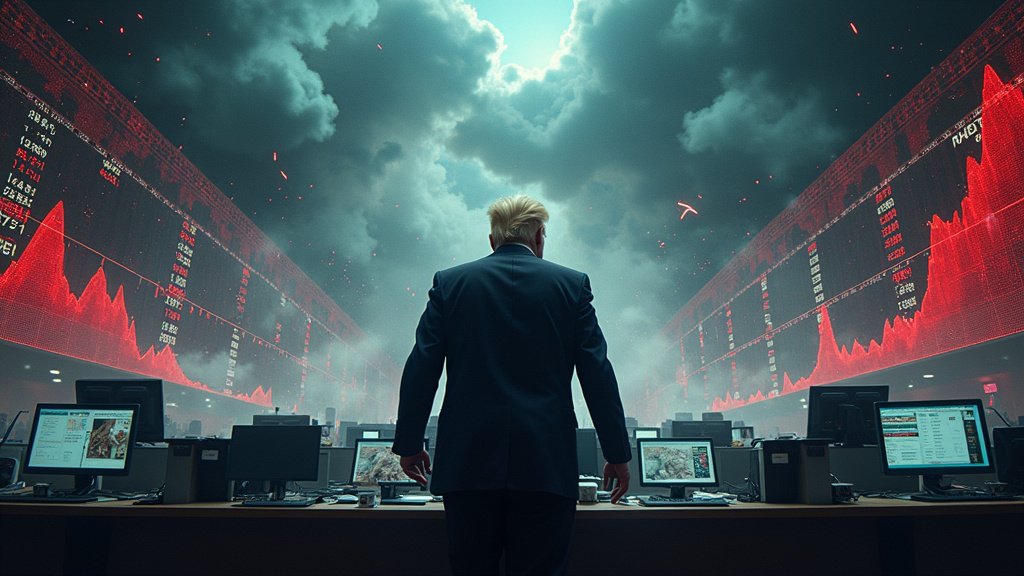
Stocks Plunge as Trump’s Tariff Threats Reignite Trade War Fears Amid Government Shutdown
Major U.S. stock indexes experienced a sharp sell-off on Friday, October 10, 2025, as President Donald Trump’s renewed threats of imposing significant tariffs on China shattered a period of market calm. The downturn was exacerbated by ongoing concerns over the prolonged U.S. government shutdown, which is beginning to take a toll on economic activity.
Markets Reel from Trade War Resurgence
The NASDAQ 100 index was hit particularly hard, tumbling by approximately 2.7%, while the broader S&P 500 fell 2.7% and the Dow Jones Industrial Average dropped 1.9%. This market reaction came after President Trump, via his social media platform, stated that his administration was considering “a massive increase of tariffs” on Chinese products, citing what he described as China becoming “hostile” regarding crucial rare earth materials. The threat alone was enough to reverse early session gains and send investors scrambling for safer assets.
The VIX, a key measure of market volatility often referred to as the “fear index,” surged significantly, reaching its highest level in months. This jump in volatility reflected heightened investor uncertainty and a renewed apprehension about escalating global trade tensions. The market saw a considerable rush into U.S. Treasury bonds, as evidenced by the 10-year Treasury yield dropping to around 4.05%. Gold futures also resumed their ascent, climbing 1.5%.
Sectors and Assets Feeling the Heat
Big tech companies, semiconductors, and oil and gas sectors were among the hardest hit. Shares of prominent technology firms like Nvidia and Advanced Micro Devices saw notable declines, with Nvidia finishing down 4.9% and AMD sinking 7.8%. Qualcomm, a leading U.S. chipmaker, also found itself under renewed scrutiny, facing an antitrust investigation in China, which had previously resulted in a substantial fine in 2015.
Beyond traditional equities, the cryptocurrency market experienced a significant downturn. Bitcoin plummeted by around 8.4%, while Ethereum saw a steeper drop of over 15%. This crypto “flash crash” resulted in billions of dollars in liquidations, with some analysts describing it as one of the darkest periods in the digital asset’s history. Investors appeared to be dumping riskier assets, including cryptocurrencies, in favor of perceived safe havens like Treasury bonds and gold.
The Shadow of the Government Shutdown
Compounding the market’s anxiety was the ongoing federal government shutdown, which had already entered its tenth day by October 10th and was projected to continue without immediate resolution. The Congressional Budget Office (CBO) estimated that the shutdown could cost the U.S. economy between $7 billion and $14 billion, reducing GDP by 1 to 2 percentage points in the fourth quarter of 2025. The prolonged closure delayed the release of crucial economic data, hindering the Federal Reserve’s ability to assess the economic landscape and potentially influencing its monetary policy decisions. Federal employees facing delayed paychecks also contributed to concerns about reduced consumer spending and overall economic activity.
Background and Potential De-escalation
These recent tariff threats by the U.S. followed a period where China had implemented its own retaliatory measures, including new port fees and the antitrust probe against Qualcomm. However, in late October 2025, following high-level talks in Kuala Lumpur and a meeting between Presidents Trump and Xi in South Korea, both nations announced a framework agreement to ease trade tensions. This agreement included suspending certain tariffs and export restrictions for a year, offering a potential de-escalation that could provide relief for businesses and markets in the near future. The U.S. would halve its fentanyl-linked tariff on Chinese goods, and China would pause its rare earth export restrictions. This news business cycle will continue to be watched closely.
While the immediate market reaction on October 10th was a sharp decline, the subsequent de-escalation efforts from the U.S. and China offered a glimmer of hope for a more stable economic outlook. Nevertheless, the volatility underscored the fragility of global trade relations and the significant impact of geopolitical developments on financial markets.

Related Posts