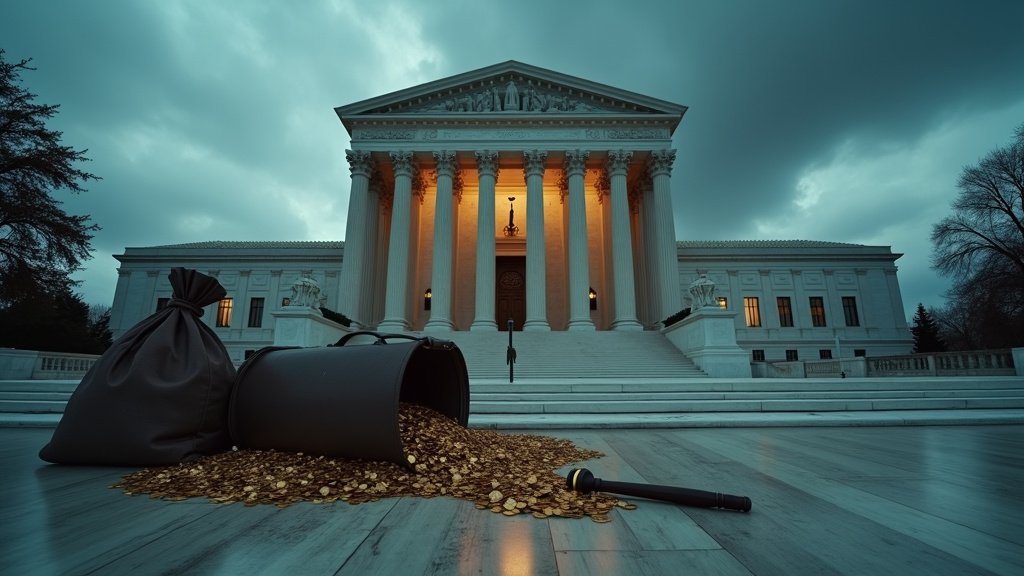
US Supreme Court Strikes Down Trump Tariffs, Ignites Refund Uncertainty and New Trade Battles
US Supreme Court Ruling Creates Tariff Refund Uncertainty for Businesses
A recent US Supreme Court decision has dramatically limited presidential authority over tariffs. The court ruled 6-3 that the International Emergency Economic Powers Act (IEEPA) does not grant the president power to impose tariffs. This landmark ruling invalidates many tariffs enacted during President Trump’s second term. Consequently, this news sparks significant uncertainty for businesses. Many are now awaiting refunds for tariffs they have already paid.
Background of the Ruling
The dispute centered on tariffs imposed using the IEEPA. President Trump utilized this law to address national emergencies. These included issues like illegal immigration and trade deficits. Tariffs were applied to goods from Canada, Mexico, China, and many other nations. Companies and trade groups challenged these levies. They argued the president exceeded his authority. The core argument was that Congress, not the president, holds the power to tax.
The Supreme Court’s Decision
The Supreme Court’s majority opinion affirmed this view. Chief Justice John Roberts wrote that the Constitution grants Congress the power to tax. He stated that IEEPA does not explicitly delegate tariff-setting power to the president. The Court reasoned that “regulating” imports does not automatically include imposing revenue-raising duties. This decision strictly limits the executive branch’s ability to unilaterally implement broad tariffs. It underscores the principle of separation of powers. The ruling specifically impacted “trafficking” tariffs and “reciprocal” tariffs. However, it did not affect tariffs imposed under other statutes like Section 232 or Section 301.
Uncertainty for Businesses Awaiting Refunds
A major consequence of the ruling is the uncertainty surrounding tariff refunds. The Supreme Court did not specify a process for reimbursements. This has left many businesses confused. The estimated total value of tariffs paid could be as high as $175 billion. Some business associations are demanding swift refunds. Organizations like the US Chamber of Commerce and the National Retail Federation are calling for a simple process. They believe refunds will boost economic growth. Companies like FedEx have already filed lawsuits seeking full repayment. These legal actions suggest lengthy court battles may follow. Small businesses, in particular, faced significant financial strain. They may have taken out loans or delayed investments due to tariff costs.
Presidential Response and New Tariffs
President Trump reacted strongly to the ruling. He called the decision “terrible” and an “embarrassment.” Despite the court’s check on his authority, he signaled intent to continue his tariff agenda. Within hours, he announced a new 10% global tariff. He then raised this to 15%. This was done under Section 122 of the Trade Act of 1974. This action aims to circumvent the Supreme Court’s ruling. However, these new tariffs are temporary. They are set to expire in 150 days unless Congress approves an extension. This move has generated further market uncertainty.
Broader Economic and Global Impact
The recent news impacts global trade dynamics. Asian economies are assessing the consequences. Countries like Japan and Taiwan are closely monitoring developments. They fear increased uncertainty for their export markets. Europe has stated it will not accept increased U.S. tariffs. The European Union has paused ratification of a trade deal with the U.S. Officials seek clarity on how the new tariffs will affect their agreement. They emphasize that “a deal is a deal.” This ruling creates instability for international trade relationships. It highlights a shift toward greater reliance on clear congressional authorization for such economic measures. Businesses now face a complex trade policy landscape. The path forward remains unclear. The potential for further legal challenges and trade disputes is high. This ongoing news cycle affects global market sentiment. It influences investment decisions and supply chain strategies worldwide. Businesses are urged to consult legal counsel. This helps them preserve potential refund claims.
Conclusion
The Supreme Court’s decision marks a significant moment. It reasserts congressional power over tariffs. However, it has created a period of uncertainty for businesses. The lack of a clear refund process and the president’s subsequent actions introduce new challenges. Businesses and international partners will closely watch future developments. The outcome will shape future U.S. trade policy. It will also affect global economic stability.

Related Posts