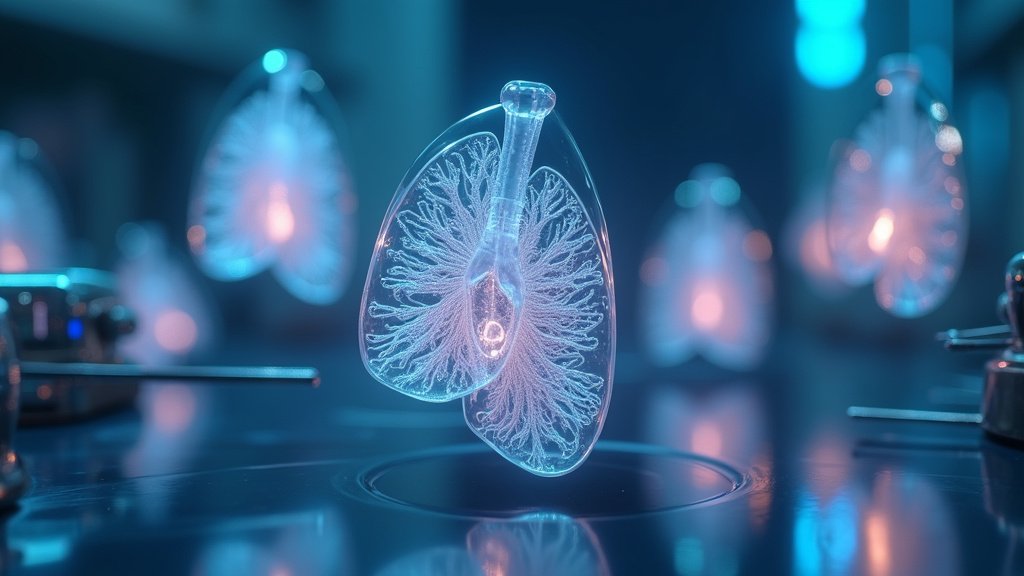
Automated Mini Lungs: Breakthrough Promises Faster, Personalized Cancer Treatments
Scientists achieved a major breakthrough, developing an automated method for creating Mini Lung Organoids in large batches. This innovation could transform cancer treatment, offering a faster path to personalized medicine and revolutionizing lung organoid production.
Understanding Mini Lung Organoids
Organoids are tiny 3D models that mimic real organs, containing key cell types and replicating the organ’s architecture. Mini Lung Organoids closely resemble actual lungs and offer a powerful research tool. Previous methods for lung organoid production were manual and slow, limiting their broad use. New advances, particularly in creating Mini Lung Organoids, are changing this landscape.
A Revolution in Mini Lung Organoid Production
Researchers created a simple automated process for manufacturing lung organoids in bulk. This system for lung organoid production uses a stirred, oxygen-infused growth tank. This automated approach significantly reduces manual labor and is a featured advancement in recent news. This scalability is crucial for research, allowing for high-throughput testing and making Mini Lung Organoids more accessible. The goal is affordable, reproducible organoids, overcoming a major hurdle in cancer research tools.
Personalized Cancer Treatment with Mini Lung Organoids
Lung cancer is a major global killer, presenting complex treatment challenges, especially drug resistance. Traditional research models have limitations and do not always capture patient-specific differences. Organoids offer a better solution. They can be grown from a patient’s own cells, becoming patient-derived organoids. These patient-derived organoids mimic individual tumors, preserving unique features like genomic alterations and drug response patterns, making them invaluable as cancer research tools and in developing personalized cancer therapy.
Testing Therapies Before Treatment Using Mini Lung Organoids
These personalized organoids act as mini-patients, allowing doctors to test drugs in the lab before actual patient treatment. This approach can predict treatment success and potential resistance, enabling clinicians to choose the best therapy and avoid ineffective or harmful drugs. This accelerates the development of new medications, representing a featured step toward precision oncology and a significant cancer treatment breakthrough.
Faster Drug Discovery with Mini Lung Organoids
Organoids provide a more accurate model than 2D cell cultures or animal models, particularly for drug screening. The automated bulk production of Mini Lung Organoids greatly aids this, enabling widespread drug testing. Researchers can evaluate many compounds, speeding up the discovery pipeline and reducing time and cost. Scientists aim to use Mini Lung Organoids without animal material, a significant ethical and practical benefit for drug discovery models.
Insights into Cancer’s Start with Mini Lung Organoids
These Mini Lung Organoids offer deeper insights, helping to study how cancer begins and how stem cells turn cancerous. This knowledge is vital for early intervention. Researchers can identify new drug targets and block tumor progression early. This is a critical area of recent focus, and understanding cancer’s initial steps is key to developing effective cancer treatment breakthrough strategies.
Broader Applications of Mini Lung Organoids
While cancer is a major focus, organoids have wider uses. They help model other lung diseases, aid in understanding lung development, and assist in studying host-pathogen interactions, including viruses like SARS-CoV-2. Organoid technology, including Mini Lung Organoids, is transforming many research areas, connecting lab findings to clinical reality.
Future Prospects for Mini Lung Organoids
The automated production of Mini Lung Organoids is a landmark, promising to revolutionize how we fight lung disease and offering a path to truly personalized medicine. This news highlights ongoing progress. Future work will refine organoid models and explore integration with other technologies like AI and organ-on-a-chip systems. The goal is faster, more effective treatments through advanced drug discovery models and better personalized cancer therapy. This technology represents a significant leap forward, bringing hope for millions facing lung conditions.

Related Posts