2026 Technology Landscape: AI, Autonomy, and Immersive Futures Take Center Stage
The year 2026 is poised to be a watershed moment for technological innovation, characterized by the accelerating integration of artificial intelligence and a significant shift towards autonomous systems and immersive experiences. This upcoming period promises to redefine industries, reshape the workforce, and fundamentally alter how humans interact with digital and physical environments. Recent advancements and emerging news highlight a clear trajectory, with AI not just as a tool, but as a foundational driver of progress.
The Ascent of Agentic and Generative AI
Artificial intelligence is set to move beyond its current applications, with agentic AI evolving from mere assistance to full autonomy. These sophisticated systems are projected to handle complex, end-to-end workflows independently, coordinating projects and interacting with external stakeholders to achieve long-term goals. Concurrently, generative AI is transitioning from experimental pilots to enterprise-grade integration. By 2026, it’s anticipated that 80% of enterprises will have utilized generative AI APIs or deployed generative AI-enabled applications, making it a critical component for content creation, code generation, and novel problem-solving. This rapid adoption necessitates a robust framework for AI governance and regulation, which will shift from being optional to central in technology trends and policy discussions. Emerging regulatory landscapes, such as the EU AI Act fully coming into force by August 2026, underscore the growing importance of transparency, accountability, and ethical considerations in AI deployment.
Intelligent Automation and Cognitive Processes Emerge
The broader trend of intelligent automation is set to intensify, with hyperautomation becoming a standard practice. These systems will not only automate repetitive tasks but also tackle complex decision-making processes, leveraging AI for enhanced insights and operational efficiency. AI copilots and Retrieval-Augmented Generation (RAG)-powered systems will become integral to knowledge work, assisting employees with tasks ranging from document review to complex technical design, thereby boosting productivity and decision quality.
Redefining Human-Machine Interaction: Neural Interfaces and Extended Reality
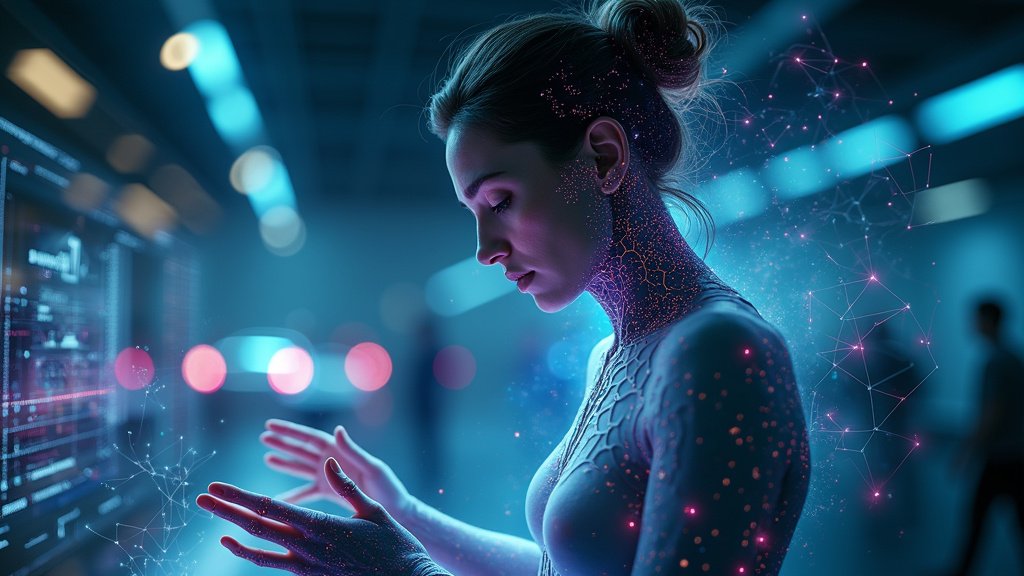
Neural interfaces, the cutting-edge technology that merges biology with computing, are moving from research laboratories into real-world settings. Breakthroughs in signal processing and non-invasive sensor design are paving the way for applications that could restore function for individuals with paralysis and potentially treat neurodegenerative diseases. In parallel, Extended Reality (XR), encompassing Augmented Reality (AR) and Virtual Reality (VR), is expected to see widespread adoption. AR glasses, in particular, are projected to become a mainstream interface, potentially replacing traditional screens and offering context-rich, real-time information overlays for daily life and professional use. This technology is set to revolutionize fields like retail, education, and remote collaboration.
Democratizing Development and Fostering Responsible Tech
The landscape of software development is being reshaped by the exponential growth of low-code and no-code platforms. By 2026, an estimated 70-75% of new enterprise applications are expected to be built using these tools, empowering a new wave of ‘citizen developers’ from non-IT departments. The integration of AI into these platforms further accelerates development, automates processes, and enhances application capabilities. Alongside this democratization of development, a critical focus will be placed on AI Trust, Risk, and Security Management (AI TRiSM), ensuring that AI systems are transparent, trustworthy, and secure.
Foundational and Specialized Advancements
Beyond AI, other foundational technologies are making significant strides. Quantum computing, once confined to research, is beginning to see its first real-world applications, accelerating drug discovery, materials science simulations, and complex financial modeling. Meanwhile, the push for sustainable technology and green computing is gaining momentum, driven by environmental concerns and the need for energy-efficient digital solutions.
The Evolving Workforce and Evolving Security Paradigms
The impact of AI and automation on the global workforce will continue to be a significant area of focus. Projections suggest that a substantial percentage of current roles may be disrupted by 2027, while millions of new tech-centric roles will emerge. AI fluency and the ability to collaborate effectively with AI systems will become essential skills. In parallel, cybersecurity is entering an era of intensified competition, often described as an AI-driven arms race, necessitating advanced defense strategies and the development of quantum-resistant encryption methods.
Conclusion
As 2026 approaches, the convergence of these groundbreaking technologies—from highly autonomous AI and immersive XR to democratized development tools and advanced computing—signals a future of unprecedented capability. The news surrounding these advancements indicates a world where technology is not just smarter, but more integrated, more autonomous, and more impactful on every facet of human existence. Navigating this transformative period will require agility, foresight, and a commitment to responsible innovation.

Related Posts