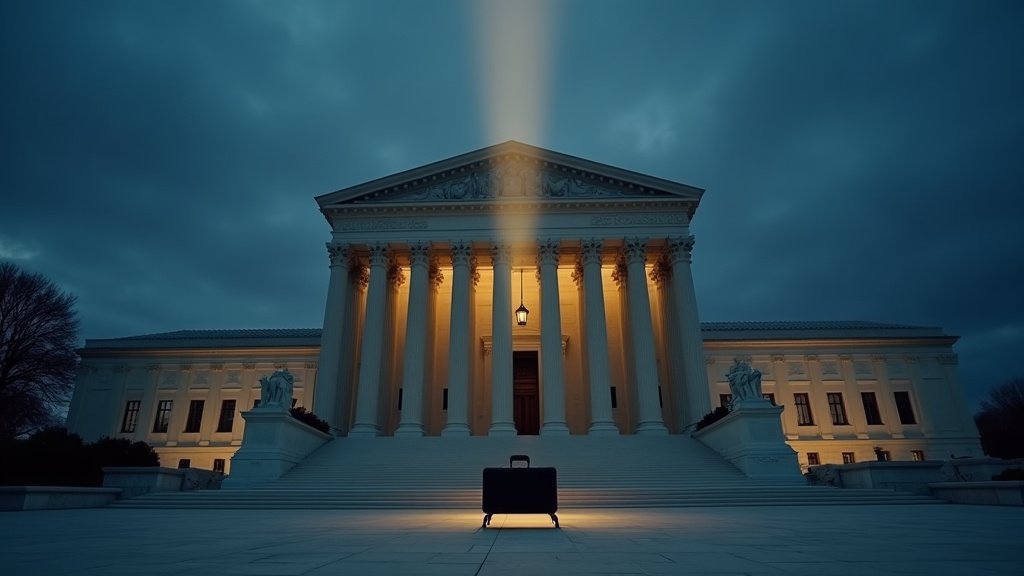
Supreme Court Rejects Trump’s Global Tariffs, Citing Lack of Congressional Authority
U.S. Supreme Court Strikes Down Trump’s Global Tariffs in Landmark Ruling
The U.S. Supreme Court issued a significant decision Friday, February 20, 2026. It struck down President Donald Trump’s broad global tariffs. This ruling marks a major blow to his economic agenda. It also sets limits on presidential power. The Court voted 6-3. Chief Justice John Roberts wrote the majority opinion. The decision targets tariffs imposed under the International Emergency Economic Powers Act (IEEPA). The Court found this law does not grant presidents the power to set tariffs.
The Court’s Decision Explained
The Supreme Court’s ruling centers on the IEEPA. This 1977 law allows presidents to act during national emergencies. Trump used it extensively. He declared emergencies for trade deficits and drug trafficking. However, the Court found IEEPA does not explicitly authorize tariffs. Chief Justice Roberts stated the Constitution gives Congress the power to tax. He wrote that the President must show clear congressional authority for such actions. The majority found that IEEPA’s language does not provide this authority. Two of Trump’s own appointees joined the majority. They were Justices Gorsuch and Barrett. Justices Alito, Thomas, and Kavanaugh dissented. They believed the tariffs were lawful.
Background of the Tariffs
President Trump viewed tariffs as a key policy tool. He used them to renegotiate trade deals. He also used them to pressure other countries. These tariffs became central to a global trade war. They strained relationships with allies. They also created economic uncertainty worldwide. Trump claimed these tariffs protected American industries. He also argued they generated revenue. However, data showed trade deficits continued to grow. The IEEPA tariffs were first implemented in February 2025. They targeted nearly every U.S. trading partner. Trump cited national emergencies for these actions.
Legal Challenges and Key Players
The Supreme Court’s decision came after several legal challenges. Businesses and states filed lawsuits. They argued Trump exceeded his authority. New York Attorney General Letitia James led a coalition of 12 states. Many lower courts sided with the challengers. They ruled that IEEPA did not authorize tariffs. The Trump administration sought to uphold the tariffs. They argued IEEPA’s broad powers included tariffs. The case marked a significant test of executive power. It was the first major part of Trump’s agenda to reach the Supreme Court.
Implications for Global Trade and the Economy
This recent news has vast implications. Global trade patterns could shift. The ruling curtails a key tool for presidential economic policy. It limits how presidents can use emergency powers. The government will stop collecting IEEPA tariff revenue. This amounts to billions of dollars annually. As of mid-December 2025, about $130 billion had been collected. This decision may lead to many refund claims. Companies that paid these tariffs could seek their money back. This refund process might become complex. Businesses and consumers bore most of the tariff costs. The ruling offers relief by lowering import costs. It also ends uncertainty for many companies.
The Future of U.S. Tariffs
The Supreme Court’s ruling does not end all tariffs. President Trump can still use other legal authorities. These include Section 232 of the Trade Expansion Act. This section allows tariffs for national security reasons. Tariffs on steel, aluminum, and autos remain unaffected. Section 301 of the Trade Act of 1974 is another option. These authorities have more specific limitations. The administration stated it would explore these other avenues. This recent global news signals a potential shift. Future tariff actions may face stricter scrutiny. Congress’s role in trade policy is reinforced. The ruling emphasizes that tariffs require explicit congressional authorization.


Related Posts