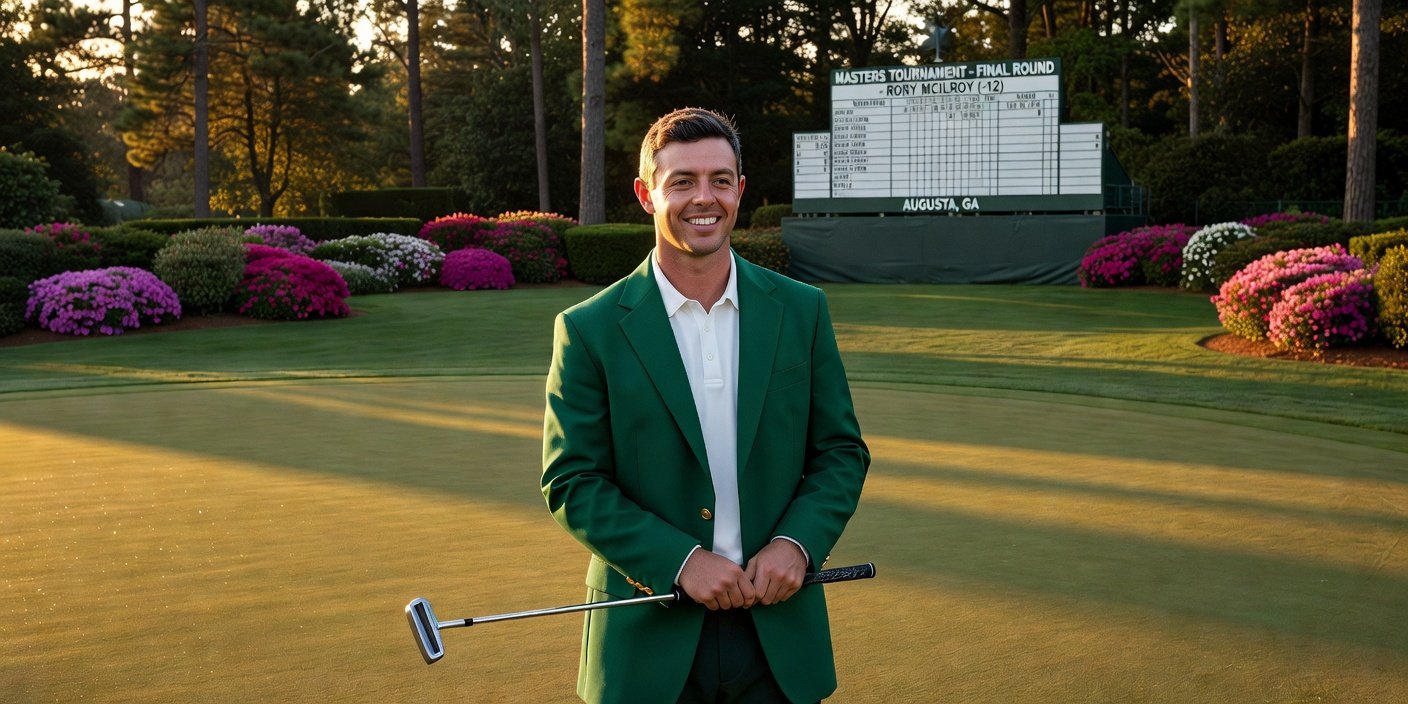
Rory McIlroy Makes History: Back-to-Back Masters Champion
In an electrifying display of perseverance and precision, Rory McIlroy has cemented his legacy in the annals of golf history, successfully defending his title at the 90th Masters Tournament. The Northern Irish superstar, having secured the career Grand Slam just one year prior, proved his dominance once again, navigating the treacherous closing holes of Augusta National to clinch his second consecutive Green Jacket. This triumph, his sixth major championship overall, places him in the ultra-exclusive company of golf’s immortals—Jack Nicklaus, Nick Faldo, and Tiger Woods—who are the only players to have successfully defended their Masters title.
Key Highlights
- Historic Repeat: McIlroy becomes just the fourth golfer in history to win back-to-back Masters, following Nicklaus, Faldo, and Woods.
- Sixth Major Victory: The win marks McIlroy’s sixth major title, further solidifying his position as one of the greatest players of the modern era.
- Amen Corner Drama: A crucial birdie at the 12th and a powerful drive at the 13th provided the necessary momentum to separate from a crowded leaderboard.
- Elite Competition: McIlroy held off a world-class field including Scottie Scheffler, who finished one stroke back, and Justin Rose, who challenged until the final stretch.
The Evolution of a Legend
The 90th Masters Tournament was not merely a golf competition; it was a psychological endurance test. Entering the weekend with the weight of the “defending champion” label, McIlroy faced early-round nerves that saw him battle through a fluctuating leaderboard. However, his capacity to reset—a skill that has defined his late-career renaissance—was on full display Sunday. Unlike his younger years, where volatility often cost him opportunities at major championships, this version of McIlroy exhibited a calculated patience that defined his play throughout the 72-hole event.
The Anatomy of the Sunday Surge
As the final round progressed, the leaderboard became a congested bottleneck of talent. Scottie Scheffler, consistently accurate, pressured McIlroy from the outset, while veteran contender Justin Rose threatened to reclaim the magic that had slipped from his grasp in previous encounters. The turning point arrived at the 12th hole—the iconic par-3 “Golden Bell” within Amen Corner.
McIlroy’s tee shot was nothing short of miraculous. With the wind swirling, he committed to a high-draw iron that landed just seven feet from the pin. The subsequent birdie sent a roar across the Georgia pines that seemed to rattle the surrounding competitors. It was a “swing of the tournament” moment, a testament to his ability to perform when the pressure is at its absolute peak. Following this up with a blistering, 350-yard drive on the 13th hole, McIlroy transitioned from a defensive posture to an aggressive closer, securing a lead he would not relinquish.
Defining a Legacy
This second consecutive Green Jacket serves as a definitive statement regarding McIlroy’s place in the pantheon of golf greats. For years, critics questioned whether he could overcome the “major championship drought” that plagued his middle career. That doubt has been thoroughly erased. With six majors now to his name, McIlroy has moved into a tie for the 12th-most major wins of all time.
What makes this specific victory so compelling is the context of his career arc. After completing the career Grand Slam in 2025, many wondered if the motivation might wane. Instead, McIlroy seems to have tapped into a newfound freedom. His post-round interview reflected this, where he candidly discussed the relief of no longer chasing the “first” Masters win, allowing him to simply play his game. This mental shift, combined with his continued physical conditioning, suggests that his window for further major dominance remains wide open.
The Impact on the PGA Tour
McIlroy’s victory is also a significant boost for the PGA Tour. In an era of fractured competition and uncertainty regarding the future of the sport’s landscape, having a global superstar who is actively winning majors provides a stabilizing narrative. His victory highlights the enduring allure of traditional major championships—the prestige of Augusta National, the history of the Green Jacket, and the unparalleled drama of Sunday afternoon golf. As he heads toward the remainder of the season, the “McIlroy factor” will undoubtedly influence ticket sales, viewership, and the overall competitiveness of the fields he enters.
FAQ: People Also Ask
How many Masters titles does Rory McIlroy now have?
Following his victory at the 90th Masters Tournament in 2026, Rory McIlroy has now won two Masters titles, having won back-to-back in 2025 and 2026.
Who are the only golfers to win back-to-back Masters?
McIlroy joins a legendary group consisting of Jack Nicklaus (1965-66), Nick Faldo (1989-90), and Tiger Woods (2001-02) as the only players to defend their Masters title successfully.
What is the significance of the 90th Masters tournament?
Beyond the competition itself, the 90th edition of the Masters carried heavy historical weight as a milestone anniversary for the tournament, which was first played in 1934 and is widely regarded as the most prestigious event in professional golf.
What does this win mean for McIlroy’s total major count?
This victory brings McIlroy’s total major championship tally to six, placing him among the all-time greats and reinforcing his status as the most successful European golfer of the modern era.


Related Posts