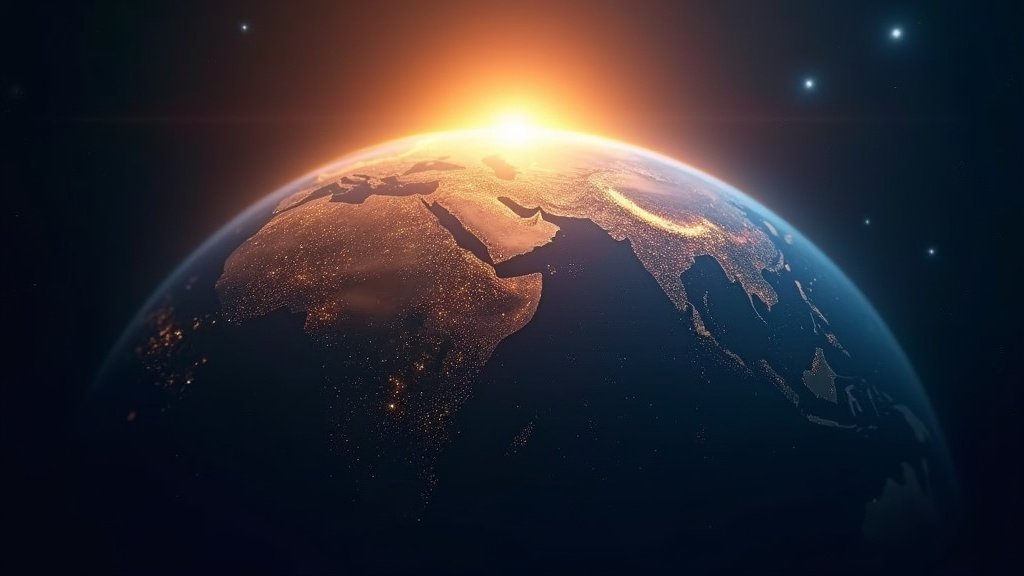
99% of Earth Sees Sunlight Simultaneously
A Shared Moment Under the Sun
On Wednesday, July 8, 2026, at precisely 11:10 GMT, a remarkable celestial alignment will occur, rendering a vast majority of humanity under daylight or twilight simultaneously. This extraordinary event, involving approximately 99% of the world’s 8.2 billion people, is not a singular anomaly but a recurring phenomenon tied to Earth’s axial tilt and the seasonal distribution of its population. For a fleeting minute, the globe will be united in experiencing natural light, a powerful reminder of our shared planet and celestial dance.
Key Highlights
- Global Daylight Alignment: On July 8, 2026, around 11:10 GMT, 99% of the Earth’s population (8.2 billion people) will experience daylight or twilight concurrently.
- Duration and Extent: This simultaneous light event lasts for approximately one minute, with daylight stretching across North America, South America, Europe, Africa, and most of Asia.
- Population Distribution: While 6.9 billion people will be in full daylight, millions more will be in civil, nautical, or astronomical twilight, with only about 83 million experiencing full night.
- Seasonal Occurrence: This phenomenon is not unique to July 8; similar conditions occur daily for about 60 days each year, from mid-May to mid-July, around the Northern Hemisphere’s summer.
- Viral Misconception: The strong association with July 8 stems from a viral social media post in 2022, which incorrectly suggested it was the only day this event occurs.
The Science Behind the Simultaneous Sunrise
Earth’s Tilt and Seasonal Influence
The key to understanding this near-universal daylight event lies in the Earth’s axial tilt of approximately 23.4 degrees. As the Earth orbits the Sun, this tilt causes different hemispheres to receive varying amounts of direct sunlight throughout the year. In early July, the Northern Hemisphere is tilted towards the Sun, resulting in long summer days and extended periods of daylight across most of its landmasses. This seasonal tilt is the primary driver for the increased amount of the planet’s surface experiencing sunlight.
Population Geography: A Crucial Factor
While the Earth’s tilt dictates the distribution of sunlight, human geography plays an equally critical role in this phenomenon. The world’s population is not evenly distributed; a significant majority, nearly nine out of every ten people, reside north of the Equator. This concentration of humanity in the Northern Hemisphere, which is experiencing summer during early July, means that a greater proportion of the global population is positioned to receive sunlight simultaneously. The areas that will remain in darkness are primarily Australia, New Zealand, parts of Southeast Asia, and the surrounding oceans, regions that are less populated.
Defining Daylight and Twilight
At the precise moment of alignment on July 8, the illumination will vary across the globe. Of the 8.2 billion people experiencing some form of natural light, approximately 6.9 billion (83%) will be in full daylight. An additional 581 million (7%) will be in civil twilight, characterized by sufficient light for most outdoor activities. Nautical twilight will be experienced by 498 million people (6%), where the horizon is visible but the sky is noticeably darker. A further 249 million (3%) will be in astronomical twilight, with only a faint glow before complete darkness. Ultimately, only about 83 million people (1%) will experience full night.
The July 8 Phenomenon: A Viral Misunderstanding
The specific date of July 8 has become intrinsically linked with this event due to a viral social media post in 2022. This post inaccurately claimed that July 8 was the only day on which 99% of the Earth’s population would experience daylight simultaneously. Subsequent fact-checking by reputable sources, such as Time and Date, clarified that while July 8 is indeed a date with a particularly strong overlap, similar conditions occur daily for approximately 60 days each year. This period generally spans from mid-May to mid-July, encompassing the Northern Hemisphere’s summer solstice and the subsequent shift in the Sun’s apparent position.
Why Not the Solstice?
Although the summer solstice (around June 21) marks the longest day in the Northern Hemisphere, the subsequent days see the Sun begin to shift its apparent path southward. This shift causes daylight to recede slightly from the very northernmost, sparsely populated regions while extending further into more densely populated areas closer to the equator, such as Indonesia and the Philippines. This subtle redistribution of daylight can actually bring approximately 10 million more people into the daylight or twilight zones compared to the solstice itself, contributing to the significant overlap observed around July 8.
The Broader Implications of Shared Light
Beyond the scientific explanation, this event serves as a profound reminder of our interconnectedness. It highlights how astronomical events, combined with geographical factors, can create shared human experiences across vast distances. For most individuals, the brief minute will pass unnoticed, appearing as just another ordinary moment of day or twilight. Yet, for those aware, it offers a unique perspective on our place within the global community, all under the same sun, albeit at different times.
FAQ: People Also Ask
Q1: What time will 99% of people on Earth see sunlight or twilight on July 8, 2026?
A1: The peak moment is expected at approximately 11:10 GMT on July 8, 2026. This translates to different local times depending on the time zone, for example, 5:05 PM in Nepal and 7:15 AM on the US East Coast.
Q2: Is July 8 the only day this phenomenon occurs?
A2: No, this is a common misconception. While July 8 is one of the days with the greatest overlap, similar conditions occur daily for about 60 days each year, from roughly May 18 to July 17, during the Northern Hemisphere’s summer.
Q3: Which regions of the Earth will experience darkness during this event?
A3: During this moment, areas like Australia, New Zealand, parts of Southeast Asia, and the surrounding oceans will be in darkness. A small fraction of the global population, approximately 83 million people, will experience full night.
Q4: Why does this event happen around July 8 and not on the June solstice?
A4: After the June solstice, the Sun begins to move south. This shift causes daylight to retreat from sparsely populated northern regions and extend into more populated areas in the south, increasing the number of people experiencing daylight or twilight.
Q5: How is this event different from a solar eclipse?
A5: Unlike a solar eclipse, which is a specific astronomical event visible only from certain locations, this phenomenon is a result of Earth’s normal rotation and orbit in conjunction with population distribution. It does not require special equipment and will appear as ordinary daylight or twilight to most observers.


Related Posts