
Ray Bradbury’s Green Town: Waukegan Opens Permanent Exhibit
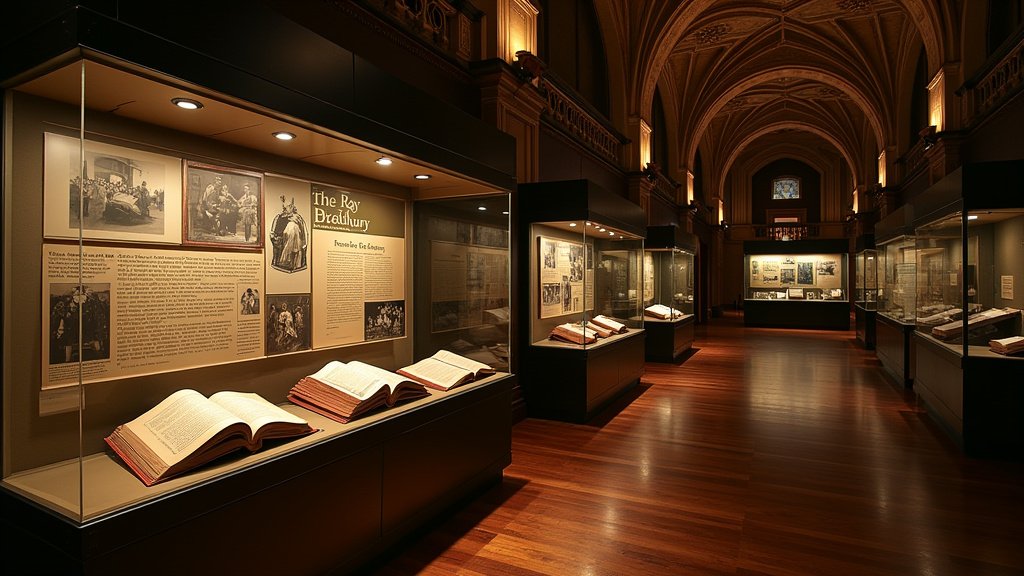
The Waukegan History Museum, housed within the architectural gem that is the Carnegie Library, has officially inaugurated a permanent, immersive exhibit dedicated to the city’s most celebrated son: Ray Bradbury. This new installation serves as a sanctuary for literary enthusiasts and scholars alike, offering a tactile exploration of the man behind ‘Fahrenheit 451’ and ‘The Martian Chronicles.’ Located in the heart of Bowen Park, this exhibit transforms the historic space into a vibrant tapestry of Bradbury’s life, pulling back the curtain on the formative years that shaped his expansive, genre-defining imagination.
Key Highlights
- Permanent Installation: A new, immersive experience at the Waukegan History Museum, located in the iconic Carnegie Library building, is now open to the public.
- Literary Pilgrimage: The exhibit features exclusive artifacts, photographs, and interpretive displays exploring Bradbury’s life as a Waukegan native.
- Green Town Origins: Visitors can trace the real-world inspirations for the author’s ‘Green Town’ trilogy, specifically ‘Dandelion Wine’, ‘Something Wicked This Way Comes’, and ‘Farewell Summer’.
- Historical Preservation: The initiative marks a significant effort by the Waukegan Historical Society to solidify the city’s identity as a major site in American literary history.
The Literary Architecture of Green Town
For decades, Ray Bradbury fans have made the pilgrimage to Waukegan, Illinois, seeking the physical geography that underpinned his most nostalgic works. While many authors build worlds from the ether, Bradbury built his upon the brick-and-mortar reality of his hometown. This new permanent exhibit effectively bridges the gap between the mundane reality of early 20th-century Midwestern life and the fantastical, often surreal, landscapes of Bradbury’s prose. The exhibit is not merely a collection of books; it is an interpretive space that invites visitors to understand Waukegan through the lens of a storyteller who famously stated that he was ‘born in 1920 in Waukegan, Illinois.’
The Carnegie Connection: A Childhood Haven
There is a profound, poetic synergy in placing this exhibit within the Carnegie Library building. For a young Ray Bradbury, the library was not just a repository of knowledge; it was a sanctuary. Historians and curators have highlighted how the young Bradbury spent countless hours within these very walls, reading voraciously and constructing his own internal universe. By housing the exhibit in the Carnegie structure, the Waukegan Historical Society has honored the precise location where the future titan of science fiction first learned to dream. The physical architecture of the museum—with its high ceilings and historic character—acts as a time capsule, transporting guests back to the era that defined the atmospheric tension of works like ‘Something Wicked This Way Comes’.
Mapping the Green Town Trilogy
Perhaps the most compelling section of the exhibit focuses on the ‘Green Town’ trilogy. The curators have meticulously laid out the map of the town, superimposing Bradbury’s fictionalized topography onto the actual streets of Waukegan. This provides a fascinating secondary angle: how does a town influence an artist? The exhibit demonstrates that for Bradbury, Waukegan was not just a backdrop; it was a character. From the ravine scenes that haunted his nightmares to the summer days that inspired the golden-hued nostalgia of ‘Dandelion Wine’, the exhibit showcases photographs, period-specific artifacts, and manuscripts that contextualize how a quiet Midwestern town became the epicenter of a literary phenomenon. This exploration of ‘literary geography’ allows visitors to walk out of the museum and see the city through a transformed perspective, turning a simple walk through Bowen Park into an exploration of American gothic and nostalgia.
The Curator’s Vision: An Immersive Archive
In an age where digital consumption is the norm, the Waukegan Historical Society has made a conscious choice to prioritize physical, immersive storytelling. The exhibit avoids the pitfalls of generic ‘author tributes.’ Instead, it utilizes environmental design to evoke the specific ‘feel’ of Bradbury’s writing. The use of lighting, textures, and curated ephemera creates a sensory experience that feels closer to a film set than a traditional museum display. This is a critical development for literary tourism. As the global interest in genre fiction and American classics remains high, Waukegan is positioning itself not just as a bedroom community for Chicago, but as a cultural destination of global significance. The permanent nature of the exhibit signals a long-term commitment to preserving this legacy for future generations of readers who will inevitably find their own way to the doors of the Carnegie.
FAQ: People Also Ask
Q: Where exactly is the new Ray Bradbury exhibit located?
A: The exhibit is located at the Waukegan History Museum, which is situated within the historic Carnegie Library building in Bowen Park, Waukegan, Illinois.
Q: What specific works are covered in the exhibit?
A: The exhibit provides comprehensive coverage of Ray Bradbury’s life, with a specific focus on the ‘Green Town’ trilogy: ‘Dandelion Wine’, ‘Something Wicked This Way Comes’, and ‘Farewell Summer’.
Q: Is this a temporary installation?
A: No, the Waukegan Historical Society has unveiled this as a permanent exhibit, ensuring it will remain a cornerstone of the museum for years to come.
Q: Does the museum offer guided tours of the Bradbury-related sites in town?
A: While the exhibit itself is within the museum, the Waukegan Historical Society often hosts events and educational programs that explore the local history; visitors are encouraged to check the official society website for the latest schedules on tours and special exhibits.


Related Posts


