
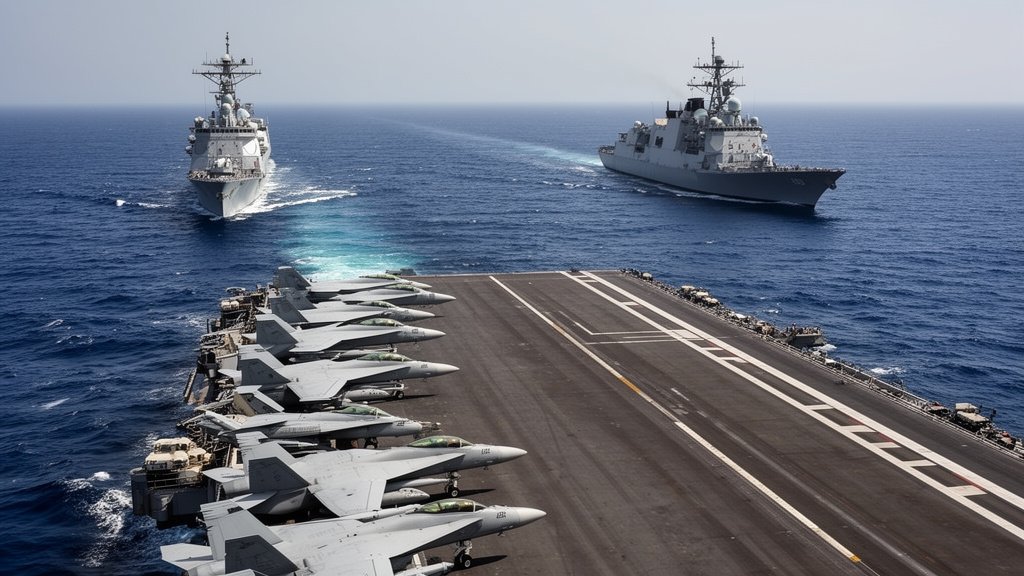
US Surges Forces, Third Carrier to Mideast Amid Iran Tensions
In a significant escalation of military posturing, the United States Department of Defense has announced a major surge of assets into the Middle East, authorizing the deployment of 10,000 additional troops and a third aircraft carrier to the region. This strategic maneuver coincides with reports that President Trump is actively weighing potential military strikes against Iran, signaling a dramatic shift in the geopolitical landscape. As regional instability mounts, the introduction of this third carrier strike group represents one of the most substantial demonstrations of American naval and expeditionary power in the CENTCOM area of responsibility in recent years.
The Strategic Pivot: Deploying a Third Carrier Strike Group
The decision to inject a third aircraft carrier into the theater of operations is a profound statement of intent. Typically, U.S. naval strategy in the Middle East operates with one to two carriers, with strike groups rotating to maintain constant coverage. By surging a third, the Pentagon is effectively tripling the offensive and defensive air-wing capacity available to regional commanders.
This deployment provides an overwhelming tactical advantage, enabling persistent air superiority, enhanced intelligence, surveillance, and reconnaissance (ISR) capabilities, and rapid-response offensive power. A single carrier strike group is a floating city of roughly 7,500 personnel, supported by a guided-missile cruiser, two destroyers, and an attack submarine. By adding a third, the U.S. is not merely reinforcing presence; it is creating a posture capable of sustaining a multi-front conflict if deterrence fails. This force concentration is specifically designed to overwhelm the anti-access/area-denial (A2/AD) strategies often employed by regional adversaries.
The 10,000-Troop Surge: Logistics and Force Protection
Beyond the naval expansion, the deployment of 10,000 additional troops introduces a massive logistical footprint to the ground theater. These units, comprising combat support, logistical specialists, and expeditionary ground forces, are critical for maintaining the sustainability of a prolonged standoff or potential offensive campaign.
Modern military operations are not won by kinetic strikes alone; they rely on the ‘tail’—the supply chain, the Patriot missile batteries, the radar installations, and the field hospitals that sustain the ‘teeth.’ These 10,000 troops are likely tasked with fortifying existing bases in the Gulf Cooperation Council (GCC) states and expanding the logistical capacity necessary to support high-tempo operations. This buildup serves a dual purpose: it provides the necessary infrastructure to project power while simultaneously hardening U.S. defensive positions against potential retaliatory drone or ballistic missile strikes from the Islamic Revolutionary Guard Corps (IRGC) or its regional proxies.
Assessing the Iran Calculus
The reported deliberation by President Trump regarding military strikes on Iran marks a pivotal moment in his administration’s foreign policy. The calculus behind this potential action likely revolves around the necessity of degrading Iran’s nuclear production capabilities and dismantling its network of regional proxies.
However, the strategic risks are immense. A military strike, no matter how surgical, carries the inherent risk of escalation into a broader, asymmetric war. Tehran possesses a deep arsenal of short-to-medium-range ballistic missiles capable of striking U.S. assets throughout the region, as well as the ability to threaten the Strait of Hormuz, the world’s most critical chokepoint for global oil transit. The White House is balancing the desire to re-establish deterrence through strength against the economic and human costs of a protracted regional conflict.
Economic Implications and Global Stability
The presence of three U.S. carrier strike groups in the region exerts immediate pressure on global energy markets. As tensions spike, volatility in oil futures is inevitable. The Strait of Hormuz remains the central artery for global energy, with nearly one-third of the world’s seaborne oil passing through its narrow waters daily.
Insurance premiums for tankers operating in the region are expected to surge, further complicating the supply chain. Global markets are currently pricing in the risk of a disruption, with investors closely watching the U.S. military’s posture for signs of de-escalation or full-scale conflict. Should the Trump administration order strikes, the immediate reaction in commodity markets could be sharp and sustained, impacting inflation rates and global economic recovery efforts across Europe and Asia.
FAQ: People Also Ask
1. What does the deployment of a ‘third’ aircraft carrier mean operationally?
Typically, the U.S. maintains one or two carriers in the region. A third carrier provides redundant capability, allowing for 24/7 air operations, vastly increased sortie rates for fighters, and the ability to cover multiple sectors of the Middle East simultaneously without stretching resources thin. It is a posture of readiness for high-intensity warfare.
2. Why are 10,000 extra troops being sent if it is an air-campaign focus?
Air campaigns require massive ground support. These troops handle the logistics of the carrier strike groups’ logistics, maintain the base runways, operate advanced missile defense systems (like Patriot or THAAD) to protect against Iranian missiles, and secure the supply lines essential for long-term power projection.
3. What are the risks of a U.S. strike on Iranian soil?
The primary risk is a direct retaliatory attack on U.S. bases in the region, the disruption of oil shipments through the Strait of Hormuz, and the activation of Iranian-backed proxies in Iraq, Syria, and Lebanon, which could lead to a multi-theater, asymmetric conflict that is difficult to conclude cleanly.
4. How does this fit into the current administration’s Iran policy?
This deployment suggests a pivot toward ‘maximum pressure’ combined with ‘deterrence by presence.’ It signals that the administration is preparing for the possibility of kinetic engagement, moving beyond sanctions and diplomatic warnings toward a credible, immediate military threat.


Related Posts


