
Six Flags Overhauls Safety: Seat Belts Added Post-Tragedy
Six Flags Entertainment Corporation has initiated significant safety upgrades, including the mandated installation of additional seat belts on select roller coasters across its properties, following the tragic death of 42-year-old Hassan Jihad Ibn Kariem. Kariem fell from the Goliath roller coaster at Six Flags Over Georgia, a catastrophic event that prompted an immediate and thorough re-evaluation of current ride restraint systems and operational protocols within the amusement industry.
Key Highlights
- Six Flags is rolling out supplemental seat belt restraints on high-intensity roller coasters to augment existing bar-locking mechanisms.
- The initiative follows the fatal incident involving Hassan Jihad Ibn Kariem, who fell from the Goliath coaster at Six Flags Over Georgia, triggering intensive safety audits.
- The company is prioritizing compliance with evolving ASTM International safety standards for amusement ride devices.
- Enhanced safety protocols are being synchronized across major regional parks to ensure consistent passenger containment regardless of rider physiology.
Rethinking Passenger Containment and Roller Coaster Engineering
The incident at Six Flags Over Georgia has served as a grim catalyst for a broader technological and procedural shift in the theme park industry. For decades, roller coaster engineering focused on the ‘lap bar’ or ‘over-the-shoulder’ restraint system as the primary method of containment. These systems, designed to provide freedom of movement while ensuring the rider remains within the car, are subject to rigorous testing by groups like ASTM International. However, the tragedy involving Hassan Jihad Ibn Kariem has brought the nuances of ride physics—specifically g-force distribution, centrifugal force, and passenger physiology—to the forefront of public and regulatory discourse.
The Mechanics of the Upgrade
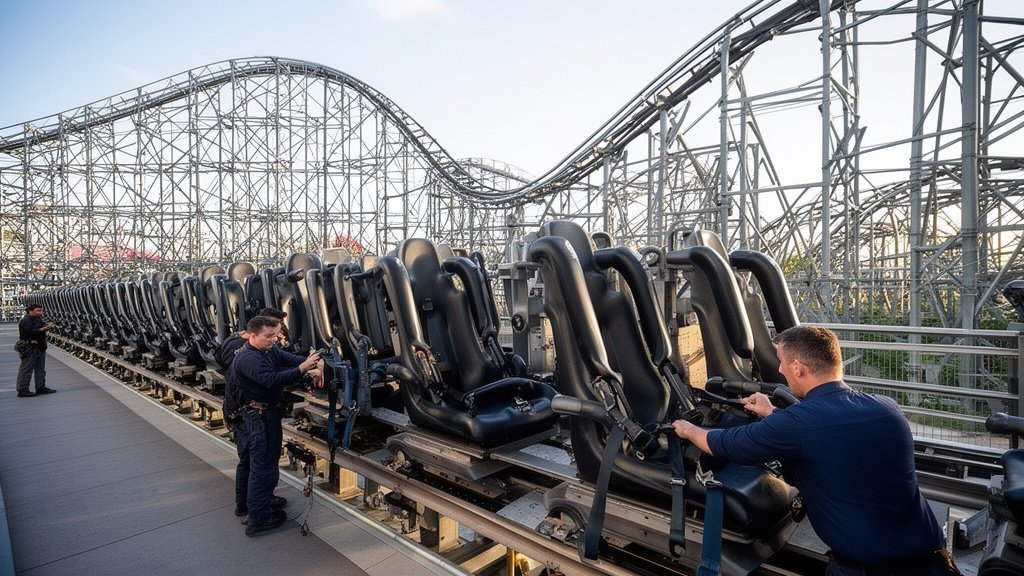
The decision to retrofit older coasters with seat belts is a move toward redundancy. In engineering terms, a primary restraint (the lap bar) coupled with a secondary restraint (the seat belt) creates a ‘fail-safe’ environment. While many modern rides are designed with these redundant systems inherently, older coasters—like the Goliath—often relied on the primary restraint system alone, which was deemed compliant with standards at the time of construction. The retrofitting process is not merely about adding a strap; it involves integrating the mounting points into the existing chassis without compromising the structural integrity of the ride vehicle. This requires heavy-duty steel welding, stress testing of the new anchorage points, and re-certification of the ride’s operational parameters by third-party inspectors before the ride can resume public operations.
Regulatory Oversight and Corporate Responsibility
Six Flags Entertainment Corporation, as a major operator of regional theme parks, faces immense pressure from state regulators, such as the Georgia Department of Labor, to demonstrate that its safety management systems are not just compliant, but proactive. The investigation into the Goliath incident focused on whether the accident was a result of mechanical failure, human error, or rider non-compliance. While investigations often point to a confluence of factors, the corporate response—implementing seat belts—suggests a strategic decision to mitigate liability and restore guest confidence. By adopting stricter standards than might be legally required in some jurisdictions, Six Flags is effectively setting a new baseline for the industry, potentially forcing smaller, independent parks to follow suit or risk regulatory sanctions.
The Impact on Guest Experience and Park Operations
Beyond the engineering, the operational impact of adding seat belts is significant. Boarding times are naturally extended when ride operators must verify that every passenger has buckled a belt in addition to securing a lap bar. This increases the load time per train, which can reduce the ‘throughput’—the number of riders per hour—that a park can accommodate. For a park like Six Flags Over Georgia, which relies on high volume during peak summer months, this is a calculated trade-off. They are effectively sacrificing a percentage of their operational efficiency in exchange for a tangible increase in perceived and actual safety. This shift reflects a wider trend in public service industries where the cost of a potential fatality far outweighs the economic cost of slower ride cycles.
Future Implications for Ride Design
This incident will likely accelerate the transition toward ‘smart’ restraints. We can anticipate future roller coaster designs that integrate sensors into the restraint system, preventing the ride from launching if the seat belt is not latched or if the lap bar is not at the precise calibrated position. The industry is moving away from purely mechanical locks toward electronic, sensor-integrated systems that provide real-time feedback to ride operators. The tragedy of the Goliath incident has accelerated the timeline for these technological adoptions, as park operators seek to eliminate the human error component from the safety equation entirely.
FAQ: People Also Ask
Q: Why were seat belts not standard on the Goliath coaster originally?
A: At the time of the ride’s construction, restraint systems were designed based on specific gravity-load calculations and passenger size requirements. The primary lap bar was deemed sufficient to prevent ejection under normal operating forces, making the additional belt redundant under the standards of that era.
Q: Will these safety updates affect the thrill factor of the rides?
A: While the physical restraints may be more restrictive, they are designed to maintain the rider’s position to prevent ejection; they do not alter the ride’s track layout, speed, or g-force profile, meaning the intensity of the coaster remains fundamentally the same.
Q: Are these retrofits being implemented at all Six Flags locations?
A: Six Flags is conducting a fleet-wide safety review. While the installation of seat belts is specific to ride-type requirements identified during these reviews, the company is prioritizing upgrades on high-intensity coasters across its nationwide portfolio.
Q: What is the role of ASTM International in these changes?
A: ASTM International develops the voluntary consensus standards for amusement rides and devices (such as F2291). While these are technically ‘voluntary,’ they are frequently adopted into law by state regulatory bodies, making compliance essential for legal operation.


Related Posts


