
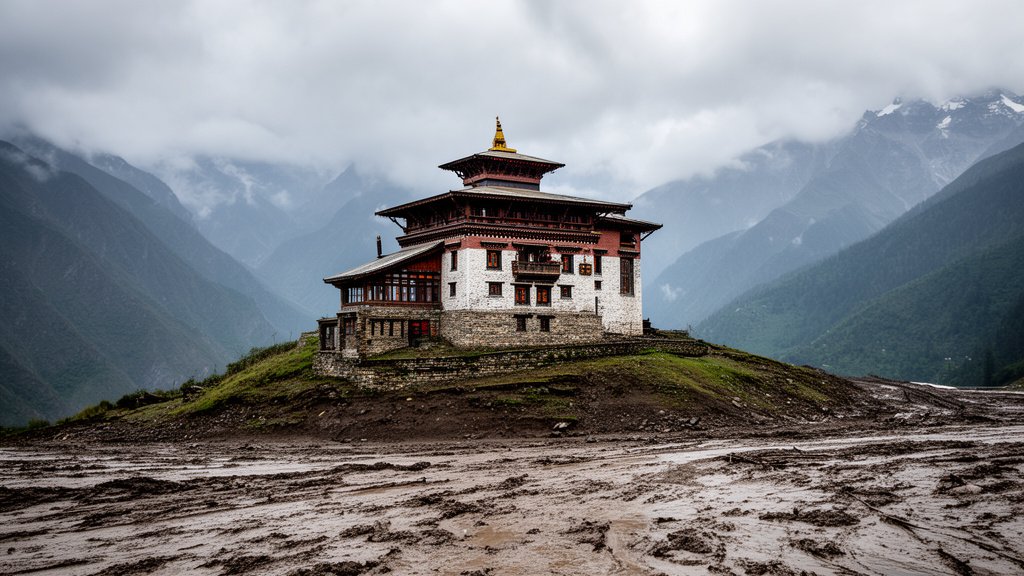
Monasteries as Bastions: Nepal’s Struggle to Save Heritage Amid Floods
In the immediate aftermath of the catastrophic flash floods that struck Nepal in late September 2024, the nation’s focus remains locked on the grim statistics: 239 lives lost and scores of communities left in absolute ruin. However, as the waters recede, a more nuanced and pervasive anxiety has emerged among the survivors, particularly those currently seeking refuge in historic monasteries. For these mountain populations, the disaster has done more than destroy homes and infrastructure; it has triggered a profound existential fear regarding the loss of cultural heritage and the rapid unraveling of the tight-knit traditions that have sustained these communities for centuries.
Key Highlights
- Devastating Toll: The September 2024 monsoon event resulted in at least 239 confirmed deaths, with the National Disaster Risk Reduction and Management Authority (NDRRMA) coordinating massive search and rescue operations.
- Monasteries as Sanctuaries: As displacement surges, high-altitude monasteries have pivoted from spiritual centers to emergency shelters, protecting thousands of displaced residents.
- Cultural Erosion: Survivors report deep distress over the potential loss of oral histories, ritual objects, and the physical spaces where community life—and ancestral memory—is preserved.
- Structural Vulnerability: Historical architecture, often built from stone and mud, has proven unable to withstand the scale of the recent, unprecedented flooding, threatening to wipe out entire local historical footprints.
The Erosion of Heritage: When Culture Meets Climate Catastrophe
The flash floods that decimated regions across Nepal, particularly impacting districts like Kavrepalanchok and parts of the Kathmandu Valley, have forced a confrontation between modern climate volatility and ancient cultural stability. While the humanitarian aid flowing into these zones is essential, the long-term impact on the social fabric of these mountain communities remains under-reported and poorly addressed.
The Monastery: A Last Bastion of Community
In the high-altitude settlements of Nepal, the monastery (or Gumba) is rarely just a place of worship. It serves as the administrative, social, and archival hub of the village. As survivors flood into these spaces, the burden on these institutions is twofold: they are physically housing the displaced, but they are also struggling to safeguard their own historical artifacts. Many monasteries are now housing hundreds of people within walls that were meant to hold meditative silence. The concern, voiced by community elders, is that the very act of conversion—turning prayer halls into dormitories—signals the breakdown of traditional life.
“The monastery is the repository of our lineage,” notes one village elder in a heavily impacted region of Kavrepalanchok. “When the water rises, it threatens the Thangkas, the ancient texts, and the space where our children learn the festivals. If we lose these, we lose the tether to our past.”
Beyond Physical Debris: The Silent Loss of Traditions
Infrastructure loss is tangible and quantifiable—roads broken, houses flattened, fields washed away. However, cultural loss is insidious. The NDRRMA has noted that the displaced populations are often cut off from their customary lands where seasonal rituals take place.
Anthropologists observing the crisis suggest that the disruption of the agricultural cycle, combined with the destruction of community centers, creates a “heritage vacuum.” When people are moved to temporary shelters, the transmission of oral traditions—which occur during collective labor in fields or festivals—is broken. For populations whose history is rarely written down and relies heavily on performance and communal living, this displacement is a critical threat to the preservation of their unique identity.
Analyzing the Economic and Structural Threat
There is a stark economic disparity between the immediate need for survival and the long-term need for cultural restoration. While international aid often prioritizes food, medical supplies, and basic shelter (which are, of course, paramount), the structural preservation of heritage sites is frequently sidelined.
Many of these mountain homes and community spaces were built using traditional techniques that, while earthquake-resistant, are struggling against the sheer volume of water experienced in the 2024 monsoons. The cost to rebuild using materials that can withstand these new, higher-intensity floods while retaining historical integrity is astronomical. Without targeted funding for heritage preservation, these communities face the risk of replacing their traditional, culturally rich architecture with generic, utilitarian structures that offer no connection to their ancestral heritage.
Secondary Angles: Resilience, Migration, and the Future
1. The Intergenerational Gap: As young people migrate away from affected areas to seek employment in cities like Kathmandu or abroad, the burden of rebuilding and preserving culture falls entirely on an aging population. The floods have accelerated this migration, as younger generations perceive the mountain life as increasingly untenable.
2. The Role of UNESCO and Global Bodies: While major heritage sites in Kathmandu are often monitored by UNESCO, remote, village-level monasteries have zero protection. There is a growing call for a decentralized disaster risk management strategy that includes the safeguarding of cultural heritage as a prerequisite for community resilience.
3. Psychosocial Impact of Displacement: Beyond trauma related to the flood itself, there is a specific, under-studied form of trauma related to the loss of “place.” For mountain communities, identity is intrinsically tied to the land and the specific geography of their villages. Being uprooted represents a fundamental breach of their sense of self, which could lead to long-term community fragmentation.
FAQ: People Also Ask
Q: Why are monasteries being used as the primary shelter for flood survivors in Nepal?
A: In remote mountain regions, monasteries are often the most structurally sound and largest community buildings available. They are naturally central, often located on higher ground, and have historically served as the primary gathering place for the community, making them the logical first point of contact for emergency shelter.
Q: What is the NDRRMA’s current role in this crisis?
A: The National Disaster Risk Reduction and Management Authority (NDRRMA) is the lead government agency responsible for coordinating the multi-sectoral response, which includes rescue operations, damage assessment, distribution of relief supplies, and managing the logistics of the displaced populations across the affected provinces.
Q: Is there funding available to help preserve cultural artifacts during these climate disasters?
A: Currently, funding is heavily skewed toward immediate life-saving support. There is a lack of specific, dedicated funding for the restoration or safeguarding of minor cultural assets (such as rural Gumbas or local shrines) at the national level, creating a gap that often falls to local community members and private donations to bridge.


Related Posts


