Paris Fashion Week S/S 2027: A Surrealist Motorway Revolution
Paris Fashion Week S/S 2027 concluded on October 6, 2026, leaving the global fashion industry breathless and recalibrating its expectations for the upcoming cycle. While the schedule was dense with emerging talent and established powerhouses, the event was irrevocably defined by a pivot toward surrealism and industrial romanticism. As editors, buyers, and celebrities departed the French capital, the consensus was clear: the S/S 2027 season marked a departure from the minimalism of the early 2020s, favoring highly conceptual, narrative-driven runway productions that mirrored the acceleration of modern life.
Key Highlights
- The Grand Finale: Paris Fashion Week S/S 2027 officially wrapped on October 6, 2026, showcasing the industry’s resilience and creative resurgence.
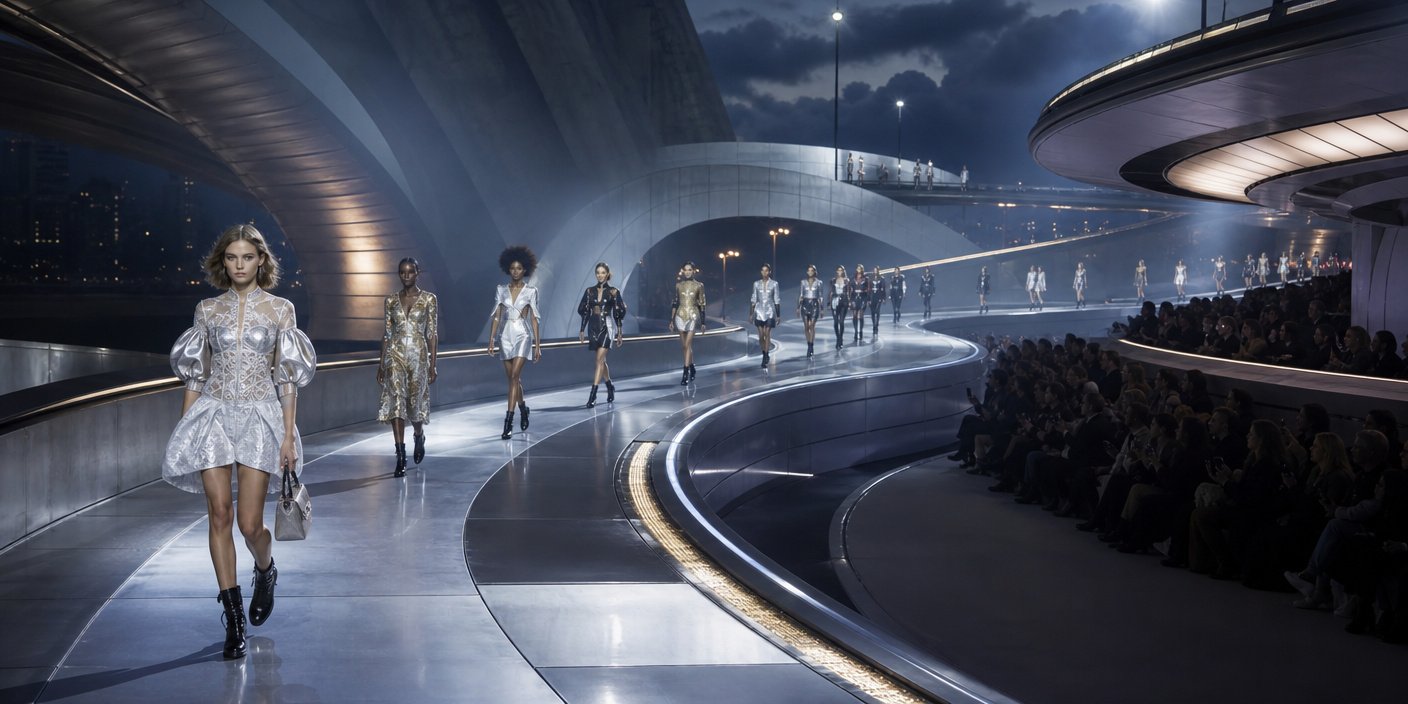
- The Motorway Motif: Nicolas Ghesquière’s Louis Vuitton collection stole the spotlight, utilizing a surreal, motorway-themed runway that blended high-octane energy with delicate, architectural construction.
- Shift in Aesthetics: The season signaled a decisive turn away from quiet luxury toward what critics are calling ‘industrial surrealism’—a fusion of raw, rugged, and metallic aesthetics with high-fashion sensibilities.
- Sustainable Innovation: A major recurring theme was the integration of ‘circular couture,’ where top-tier houses showcased materials processed through new carbon-capture and textile-recycling technologies.
The Motorway and the Muse: Deconstructing S/S 2027
The overarching narrative of Paris Fashion Week S/S 2027 was the attempt to find beauty within the frantic pace of the modern era. As the curtains fell on October 6, 2026, the industry reflected on a week where designers seemingly looked at the global state of flux—the rapid technological shifts and the persistent, unyielding velocity of digital culture—and chose to aestheticize it rather than escape it.
The Ghesquière Effect: Louis Vuitton’s Road to Surrealism
Without question, the collection that dominated the conversation was Nicolas Ghesquière’s spectacular show for Louis Vuitton. By transforming the venue into a surrealist interpretation of a motorway, Ghesquière didn’t just present clothes; he presented a state of mind. The collection itself was a masterclass in juxtaposition. Models walked a runway lined with retro-futuristic road infrastructure, wearing garments that felt both aerodynamic and deeply ornate. The use of reflective synthetic fabrics contrasted sharply with delicate, lace-like structures, creating a visual vocabulary that spoke to the fragility of humanity in a world that never stops moving. This show effectively set the tone for the rest of the week, forcing competitors and collaborators alike to raise their stakes in terms of theatrical presentation.
The Economic Pulse of the Season
The financial undercurrents of the S/S 2027 season were palpable. With the LVMH Moët Hennessy Louis Vuitton conglomerate and other major luxury players signaling increased investment in experiential marketing, the ‘show’ has become as valuable as the product. Analysts have noted that the high costs associated with these massive, high-production runway events are no longer viewed as mere marketing expenses but as critical assets for brand positioning in a hyper-competitive attention economy. The goal is no longer just to sell clothes; it is to create ‘moments’ that generate long-term digital footprints, driving brand equity across social and global media platforms long after the runway is dismantled.
Beyond the Runway: Technological and Material Evolution
While the theatricality was undeniable, the technical substance of the clothing during Paris Fashion Week S/S 2027 was equally significant. One of the most prominent secondary angles identified by trade experts was the rapid adoption of ‘Smart Materials.’ Following directives from the Federation de la Haute Couture et de la Mode regarding sustainability, many designers showcased garments treated with specialized bio-resins that alter color or texture based on environmental light. This isn’t just a gimmick; it represents a fundamental change in the supply chain. Designers are moving toward a future where clothing is not static but reactive, mirroring the adaptability required of the modern consumer.
Historical Context and Future Predictions
If we look back at the historical trajectory of Paris Fashion Week, the S/S 2027 season will likely be remembered as the moment the industry officially embraced ‘hyper-realism.’ We have moved past the era of digital-only shows, and we have moved past the era of ultra-minimalist ‘quiet luxury.’ The S/S 2027 collections suggest that we are entering an era of ‘maximalist utility.’ The clothing is designed to be worn in a world that is messy, fast, and digital, but the construction remains rooted in the unparalleled craft of Parisian couture. As we look ahead, the influence of these collections will likely dictate retail trends for the next eighteen months, with high-street brands scrambling to emulate the industrial textures and streamlined silhouettes introduced by the maisons this October.
FAQ: People Also Ask
1. When did Paris Fashion Week S/S 2027 end?
The event officially concluded on October 6, 2026, after a week of intense showcases and industry-wide events.
2. What was the theme of the Louis Vuitton show?
Nicolas Ghesquière curated a surreal, motorway-themed show. The venue and the collection explored the intersection of high-speed industrial aesthetics and delicate architectural garment construction.
3. Was sustainability a major factor at PFW S/S 2027?
Yes. Sustainability was a foundational element, with many designers focusing on circular couture and the integration of new smart, eco-friendly materials that react to environmental conditions.
4. Is Paris Fashion Week S/S 2027 focused on physical or digital shows?
It is firmly focused on physical, experiential, and high-production runway shows, prioritizing the in-person event as a critical asset for brand storytelling in the attention economy.


Related Posts