
Edouard’s Dual-Front Crisis: Texas Flooding and Northeast Power Outages
Tropical Depression Edouard has triggered a dual-front weather emergency, drenching eastern Texas with life-threatening flash floods while simultaneously battering the Northeast with damaging wind gusts. The storm, which has shown a remarkably expansive footprint, has left emergency management teams scrambling to address ground-level saturation in the south and grid-level failures in the north, affecting over 85,000 residents in the Northeast corridor alone.
Key Highlights
- Eastern Texas Flash Flooding: Sustained heavy rainfall has triggered emergency flash flood warnings, with saturation levels rising rapidly in low-lying and coastal communities.
- Northeast Power Grid Strain: Severe wind gusts associated with the system’s outer bands have knocked out power to over 85,000 residents across the Northeast.
- Emergency Response: FEMA and local state emergency departments have fully activated response protocols, prioritizing search-and-rescue for flood-impacted zones and rapid infrastructure restoration for the power grid.
- Infrastructure Vulnerability: The storm has highlighted existing weaknesses in aging utility infrastructure, as wind speeds tested the limits of regional power distribution networks.
The Meteorological Dual-Threat: Analyzing Edouard
The development of Tropical Depression Edouard presents a complex challenge for regional emergency authorities. Meteorologically, the system is characterized by a stalled, moisture-laden core hovering over eastern Texas, contrasting sharply with high-velocity wind fields affecting the Northeast. This decoupling of precipitation and wind energy creates a unique set of hazards that standard forecast models often struggle to resolve in real-time.
In eastern Texas, the concern is hydrologic. The region is experiencing what meteorologists classify as a ‘training’ effect, where successive rain bands move over the same geographical areas repeatedly. This has resulted in rapid rises in local waterways, inundating roadways and threatening residential structures. Local emergency management agencies have been forced to execute water rescues as drainage systems are quickly overwhelmed by the sheer volume of rainfall.
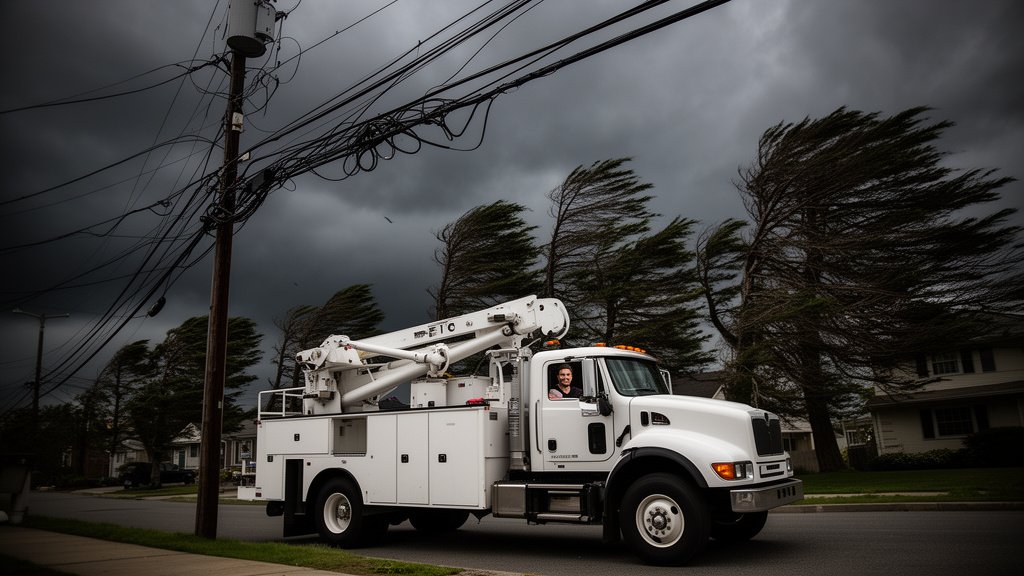
Conversely, the Northeast is facing an atmospheric disturbance defined by kinetic energy rather than saturation. As Edouard’s remnants tracked further north, they interacted with a pre-existing baroclinic zone, which effectively amplified wind speeds. These gusts have been particularly destructive to overhead utility lines, leading to the current statistic of over 85,000 residents currently without power. Utility companies are reporting that repairs are being hampered by high winds, which prevent bucket trucks and line crews from safely accessing damaged poles and transformers.
Assessing the Infrastructure Vulnerability
The mass outages in the Northeast raise critical questions regarding the resilience of modern electrical grids during extreme weather events. The failure of distribution networks serving 85,000 households is not merely a consequence of wind speed but also a reflection of vegetation management, pole integrity, and grid hardening—or the lack thereof. In many of the affected municipalities, the electrical infrastructure relies on overhead wires that are highly susceptible to falling limbs and localized turbulence. While utility providers have implemented smart-grid technology to isolate faults, the sheer volume of ‘tripped’ circuits has slowed the restoration process, leaving thousands in the dark during a period of high volatility.
Furthermore, the economic impact of these outages is significant. Beyond the immediate discomfort to residents, the loss of power disrupts local supply chains, forces the closure of schools and businesses, and places a strain on public health resources, particularly for vulnerable populations dependent on home medical equipment.
Emergency Protocols and Long-Term Resilience
FEMA, in coordination with state-level officials in Texas, has shifted into a posture of active mitigation. This involves the pre-positioning of high-water vehicles, boat teams, and shelter supplies. However, the unpredictability of ‘stalled’ systems like Edouard necessitates a dynamic approach. Residents are being urged to monitor localized flood gauges and comply with all evacuation orders.
Looking beyond the immediate recovery, policymakers are increasingly viewing these events through the lens of long-term climate adaptation. The occurrence of geographically disparate impacts—flooding in one region and high winds in another—suggests that regional emergency management needs to transition toward a more integrated, cross-state communication framework. As Edouard dissipates, the after-action reports will likely focus on whether current infrastructure standards are sufficient for the increasing frequency of such bifurcated storm systems.
FAQ: People Also Ask
What should residents in Texas do if flash flooding occurs near their homes?
If you are in a flood-prone area, prioritize moving to higher ground immediately. Do not attempt to drive through flooded roadways; ‘Turn Around, Don’t Drown’ remains the golden rule of flood safety, as it only takes a few inches of moving water to sweep a vehicle away.
Why are power outages so widespread in the Northeast despite the storm weakening?
Even as tropical systems lose their tropical characteristics, they can become ‘extratropical’ or merge with other weather systems to create powerful wind fields. The outages are caused by these high-velocity gusts, which place immense pressure on aging power distribution infrastructure.
How long will it take for power to be restored in the affected Northeast areas?
Restoration times vary by utility provider. Large-scale outages involving 85,000+ customers often require a prioritized approach, where critical infrastructure—such as hospitals, emergency centers, and water treatment facilities—are repaired first, followed by main distribution lines, and finally individual residential connections.


Related Posts


