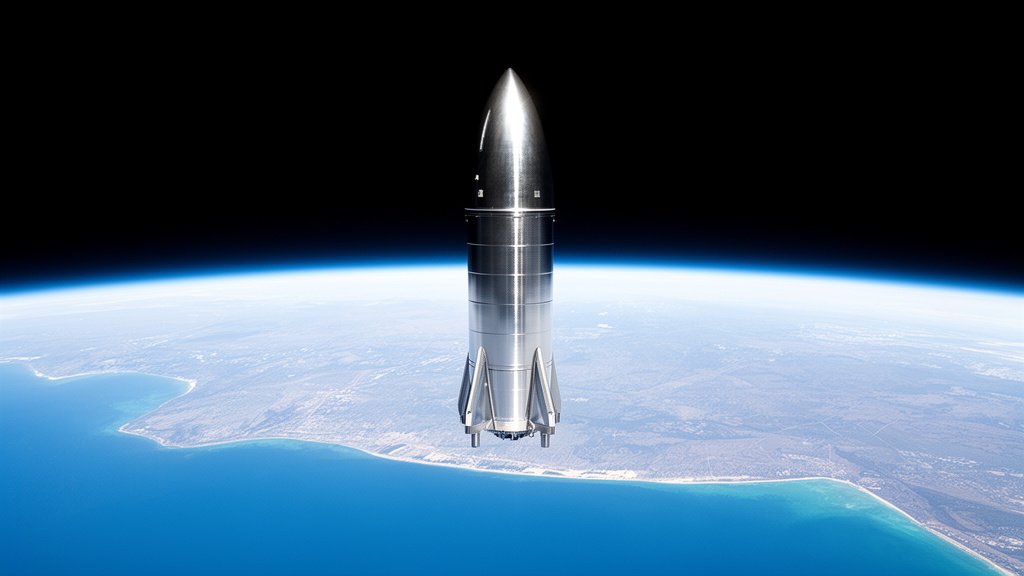
SpaceX Starship’s 13th Flight: A Bold Step Toward Mars
SpaceX successfully pushed its Super Heavy-Starship launch system to new heights on July 24, 2026, marking a pivotal 13th test flight that confirmed the viability of the upper stage’s sub-orbital hop while revealing new data regarding heavy-lift booster recovery in the Gulf of Mexico.
Key Highlights
- Milestone Achieved: The July 24, 2026, launch represents the 13th flight in the Super Heavy-Starship development cycle, demonstrating rapid iteration cycles.
- Upper Stage Success: The Starship upper stage executed a precise, successful sub-orbital hop, verifying key navigational and propulsion maneuvers in microgravity.
- Booster Recovery Data: The Super Heavy booster performed a hard splashdown in the Gulf of Mexico; engineers are currently reviewing telemetry to refine future descent profiles.
- Program Velocity: This flight confirms SpaceX’s commitment to high-cadence testing, essential for transitioning from experimental flight to operational status for NASA’s HLS and future Mars missions.
Advancing the Architecture of Rapid Reusability
The 13th test flight of the Super Heavy-Starship system was less about perfection and more about the relentless pursuit of data. In the world of aerospace engineering, particularly within the iterative design philosophy championed by SpaceX, a “hard splashdown” is not merely a failure; it is a rich data-gathering event. By subjecting the hardware to the extreme stress of reentry and water impact, engineers can stress-test structural integrity, software logic, and thermal protection systems in ways that simulations cannot replicate.
The Anatomy of the 13th Flight Profile
On July 24, 2026, the vehicle cleared the launchpad with nominal engine performance, a testament to the cumulative refinements made since previous test cycles. The primary objective for this flight—the sub-orbital hop of the upper stage—was executed with distinct precision. Throughout this phase, the Starship upper stage demonstrated stable attitude control and relight capabilities, which are essential for its eventual role in orbital insertion and long-duration space travel. This specific milestone allows the flight control team to validate the software architecture that manages the complex transitions between atmospheric and exo-atmospheric flight. The success of the upper stage confirms that the fundamental design of the Starship, intended for high-mass payloads, remains sound.
Parsing the Gulf of Mexico Splashdown
The Super Heavy booster’s hard splashdown serves as a stark reminder of the immense challenges inherent in recovering a rocket of this scale. Moving at hypersonic speeds and navigating the aerodynamic forces of descent, the booster is tasked with decelerating to near-zero velocity before touchdown. The data acquired from this hard splashdown is invaluable. Telemetry streams recorded during the final seconds before impact provide insight into the fluid dynamics and engine ignition sequencing required for a “soft” capture. This data will be ingested into the flight software models, directly informing the propulsion adjustments required for future landing attempts. For the engineering team, the Gulf of Mexico effectively serves as a massive, fluid-dynamic test bed, allowing for rapid recovery and analysis of the booster hardware.
The Broader Strategic Context
The significance of this flight extends beyond the physical hardware. With the Artemis program eyeing Starship as a pivotal element of the Human Landing System (HLS), the cadence of testing is of paramount importance. Every successful sub-orbital hop increases the reliability metrics required for crewed missions. Furthermore, the ability to operate this launch system repeatedly—rapid reusability—is the linchpin of the economics of space exploration. By proving the viability of the upper stage’s performance, SpaceX is systematically lowering the barriers to entry for heavy-lift access to orbit. The results from this 13th flight will likely accelerate the transition toward future test flights that incorporate more aggressive descent profiles and longer orbital durations. As the industry watches, the focus shifts to how the collected telemetry from the Gulf of Mexico will be applied to the next iteration of the Super Heavy, potentially marking the shift from developmental testing to commercial service readiness.
FAQ: People Also Ask
Why is the ‘hard splashdown’ considered a milestone rather than a failure?
In iterative engineering, a hard splashdown is a successful data-gathering operation. It allows engineers to test the booster’s descent control and structural integrity under real-world conditions, providing telemetry that cannot be replicated in a lab, which is crucial for refining future landing sequences.
How many Super Heavy-Starship flights have there been?
The flight on July 24, 2026, marked the 13th mission in the development program. This rapid pace is part of SpaceX’s strategy to quickly iterate on hardware design based on real-world flight data.
What is the goal of the sub-orbital hop?
The sub-orbital hop validates that the Starship upper stage can successfully navigate, maintain stability, and execute propulsion maneuvers in space. These capabilities are foundational requirements for moving toward full orbital flight and eventual deep-space exploration.
When is the next test flight expected?
While SpaceX has not released an official date for the 14th flight, the company historically maintains a high launch cadence. Following the data analysis from this mission, the next flight will likely focus on addressing the telemetry anomalies observed during the booster’s final descent.


Related Posts