
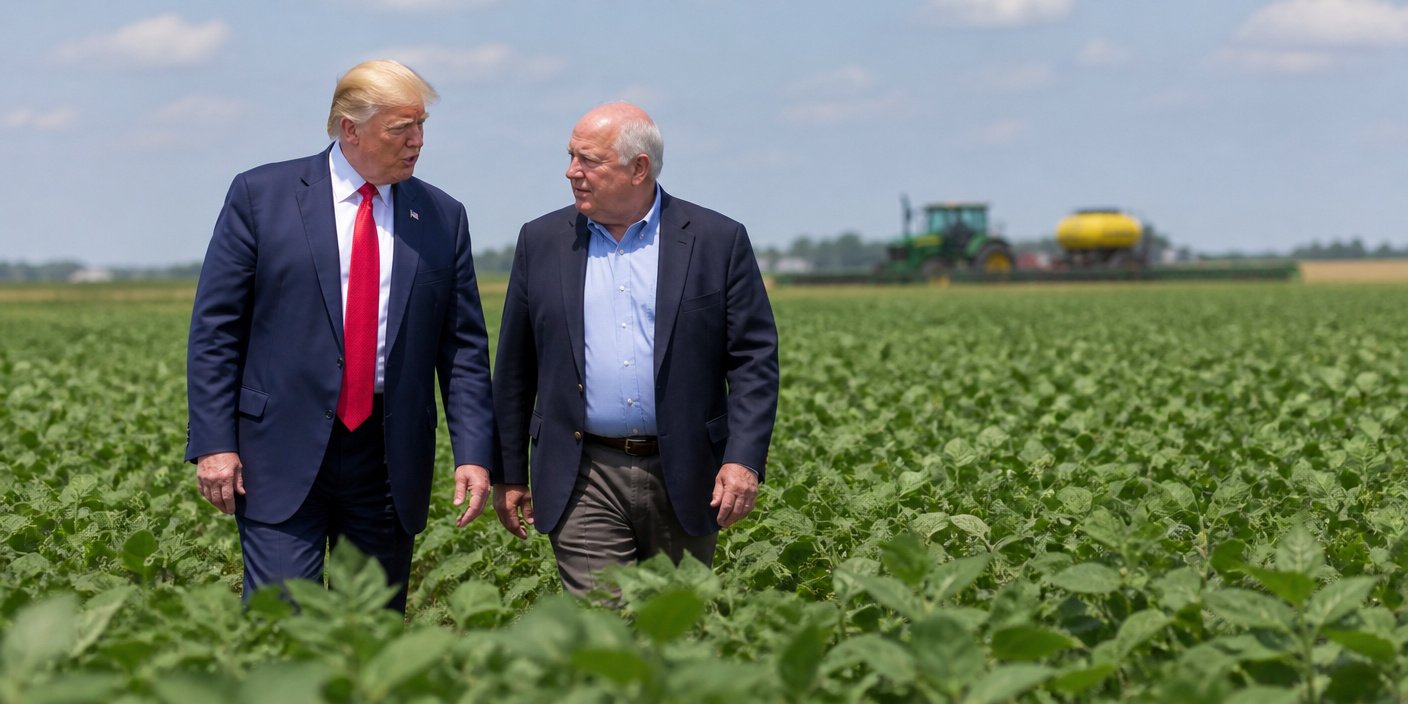
Trump’s $8 Billion Farm Aid: Stabilizing the Heartland
Amidst the escalating trade tensions of the late 2010s, President Donald Trump authorized a significant federal intervention to support the American agricultural sector. The administration unveiled a comprehensive aid package, totaling approximately $8 billion, aimed at mitigating the economic distress faced by farmers due to retaliatory tariffs and fluctuating global commodity markets. This initiative, primarily executed through the United States Department of Agriculture (USDA), became a focal point of national economic policy, underscoring the complexities of protectionist trade strategies.
Key Highlights
- Strategic Financial Support: The $8 billion package served as a direct financial lifeline for producers of major agricultural commodities, including soybeans, corn, and pork, which bore the brunt of retaliatory trade measures.
- USDA Execution: The program was spearheaded by then-Agriculture Secretary Sonny Perdue, utilizing the authority of the Commodity Credit Corporation (CCC) to bypass the need for new congressional spending legislation.
- Market Mitigation: The primary goal was to stabilize rural economies that had faced significant revenue losses and disrupted export channels, particularly in key markets such as China.
The Anatomy of the Agricultural Rescue
The announcement of the $8 billion aid package was not merely a budgetary line item; it was a calibrated response to a rapidly changing global trade landscape. By 2018, the United States found itself locked in a series of trade disputes with several major economic partners, most notably China. As the administration pursued a policy of “America First,” retaliatory tariffs were placed on a wide array of U.S. goods. American agriculture, which relies heavily on global exports, found itself on the front lines of this economic friction.
The Role of the Market Facilitation Program (MFP)
To address the immediate liquidity crisis facing farmers, the USDA launched the Market Facilitation Program (MFP). The program was designed to provide direct payments to farmers who could demonstrate a clear nexus between the trade disputes and their reduced commodity prices. By identifying specific commodities that had been targeted by foreign tariffs—such as soybeans, which saw massive market contraction in 2018—the government aimed to prevent widespread farm bankruptcies.
The decision to utilize the Commodity Credit Corporation (CCC) was significant. The CCC is a government-owned entity with the authority to engage in financial operations to support agricultural prices and income. By leveraging this existing vehicle, the administration was able to deploy resources rapidly, providing a sense of security to producers who were witnessing their profit margins evaporate in real-time.
The Socio-Economic Impact on the Farm Belt
For many farmers in the Midwest, where the impact of the tariff war was most pronounced, the aid was viewed as a necessary stopgap. However, it also sparked a broader conversation regarding the role of government subsidies in a free-market economy. Critics argued that such interventions distort natural market signals and create a long-term dependency on federal support. Conversely, proponents maintained that because the agricultural sector was being used as a bargaining chip in international diplomacy, the federal government had a moral and economic obligation to share the burden of that diplomatic strategy.
Challenges in Distribution and Equity
As with any federal program of this scale, the implementation of the $8 billion aid was not without friction. Administrative hurdles included defining eligibility criteria, determining payment rates for different commodities, and ensuring that funds reached those most impacted rather than simply the largest corporate farms. The USDA had to strike a balance between providing “quick” relief and maintaining fiscal accountability—a task that required constant adjustment of the program’s parameters as trade conditions continued to shift.
Long-Term Implications for Global Agriculture
Looking beyond the initial rollout, the trade-aid era ushered in a new chapter in how the U.S. approaches agricultural policy. The episode demonstrated that domestic agricultural stability is now inextricably linked to international trade negotiations. It also raised questions about supply chain diversification. Many farmers, having realized the vulnerability of relying on a single major export market, began to explore or advocate for more diverse trade routes and value-added agricultural products.
Furthermore, the intervention solidified the role of the USDA as a primary economic stabilization tool. The ability to deploy billions in aid on short notice set a precedent that future administrations would look to during other crises, such as the disruptions caused by global supply chain volatility in later years.
FAQ: People Also Ask
What was the specific purpose of the $8 billion aid package?
The aid package was designed to assist American farmers in coping with reduced commodity prices and export losses caused by retaliatory tariffs imposed by foreign nations during the ongoing trade disputes of the time.
How were these funds distributed to farmers?
The funds were distributed primarily through the USDA’s Market Facilitation Program (MFP). Payments were calculated based on the production of specific commodities, such as soybeans, corn, and hogs, which were directly impacted by the international trade tariffs.
Did all farmers receive the same amount of aid?
No. The aid was not a flat disbursement. Payments were structured to be proportional to the impact on specific commodities. Farmers producing crops that saw the sharpest declines in export demand due to tariffs received larger assistance relative to their production volume compared to others.
How does this affect future agricultural policy?
The reliance on the Commodity Credit Corporation (CCC) for such large-scale bailouts has set a significant precedent. It highlighted the flexibility of executive-branch powers in responding to economic emergencies, while also sparking ongoing debates about the long-term sustainability of using federal subsidies to offset trade-war losses.


Related Posts


