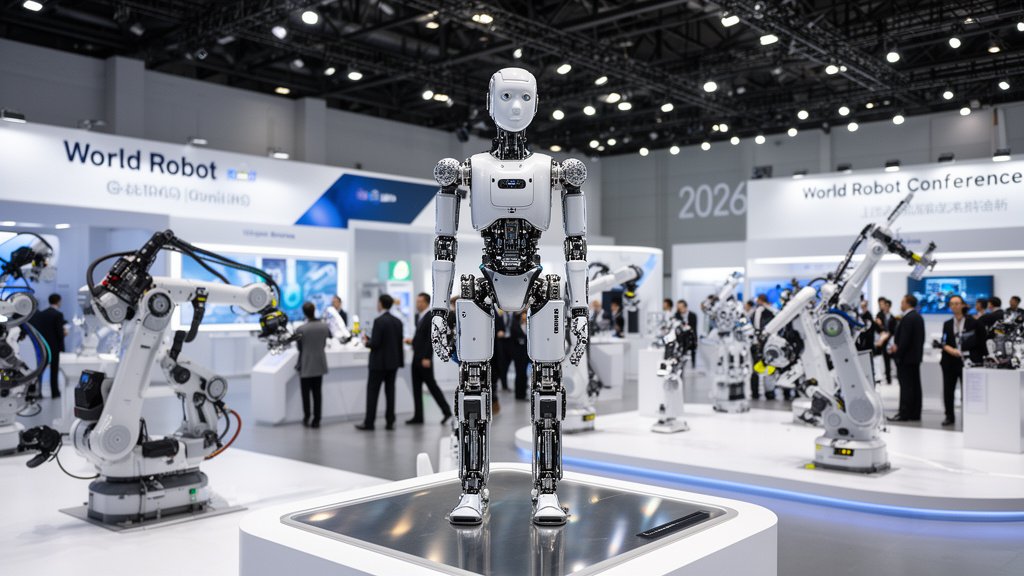
Beijing’s Robot Revolution: 3,000 Machines Defy Trade Bans
The 2026 World Robot Conference opened in Beijing today, transforming the capital into a global epicenter for advanced automation. This year’s exhibition is not merely a display of mechanical ingenuity; it is a profound declaration of intent. With over 3,000 distinct robotic products on the floor, ranging from complex industrial automatons to advanced emotional-support humanoid robots, China is aggressively asserting its dominance in a sector that has become the new frontier of global technological competition. This event underscores a pivot in China’s industrial strategy: a transition from mass-production manufacturing to high-end, AI-integrated robotics designed to fill domestic labor gaps and capture international market share, even as geopolitical trade friction and U.S.-led import bans attempt to constrain their development.
Key Highlights
- Unprecedented Scale: The conference showcases over 3,000 robotic products, highlighting the sheer breadth of China’s current R&D ecosystem.
- From Industry to Emotion: Exhibitors have shifted focus from purely functional industrial arms to complex, “emotional” humanoid robots, signaling a move toward service and care economies.
- Semiconductor Defiance: Despite U.S. import bans on advanced silicon, firms are showcasing proprietary alternatives, emphasizing a push toward technological autarky.
- Market Versatility: The displayed technologies range from sophisticated robot dogs for reconnaissance to agile bots designed for elder care and retail assistance.
Scaling the Silicon Great Wall: China’s Autonomous Future
The 2026 World Robot Conference serves as a barometer for the health of China’s technology sector. Following recent years defined by supply chain instability and U.S. export controls on high-performance semiconductors, there was significant speculation regarding the nation’s capacity to maintain its trajectory in robotics. The floor at the Beijing exhibition dispels these concerns with startling efficiency. Instead of stagnation, the industry appears to have catalyzed, pivoting toward intense domestic innovation.
The Humanoid Shift: Beyond Repetitive Tasks
Historically, the Chinese robotics sector was synonymous with industrial precision—arms meant for assembly lines and automotive manufacturing. However, the 2026 cohort demonstrates a dramatic evolution. Companies like Unitree Robotics and several state-backed research institutes are moving into ‘general purpose’ robotics. These machines are not programmed for a single repetitive task; they are being trained with large-scale neural networks to navigate unpredictable environments. The presence of humanoid robots, designed specifically for interaction rather than just production, signals a long-term plan to address the demographic challenges facing the country. With an aging workforce, the deployment of robotic caregivers is no longer a futuristic vision but a central pillar of the nation’s socio-economic planning.
Semiconductors & Sovereign Tech
One of the most scrutinized aspects of this year’s conference is the ‘under the hood’ performance of these machines. Trade friction has forced a ‘Made in China’ requirement for the critical components that power these robots—specifically high-end microchips, precision sensors, and advanced actuators. Interviews with lead engineers at the event suggest that while the earliest iterations of the 2026 lineup faced integration challenges, the current hardware is remarkably resilient. By decoupling from dependence on foreign-designed high-end chips, domestic firms are forced to optimize their own architectural designs, a process that many analysts believe will lead to a more efficient, albeit distinct, robotics standard. This technological ‘Great Wall’ is rapidly becoming a competitive advantage, as these robots are now being built from the ground up to operate in a potentially disconnected global supply chain.
The Global Export Paradox
Despite the geopolitical tension, the ambition behind these products is global. The WRC Organizing Committee has emphasized that this conference is an ‘open’ platform. The underlying tension, however, is palpable. As Chinese-made robots—cheaper, increasingly autonomous, and highly capable—hit the global market, they will inevitably compete with established U.S. and European manufacturers. If these products can match the performance of Western counterparts while maintaining a price advantage, the pressure on international regulators to manage these imports will only increase. The conference is, in essence, a showroom for the world, inviting global partners to witness a capability that will define the next decade of automation, regardless of the political headwinds.
FAQ: People Also Ask
Q: How does the U.S. import ban affect the robots on display?
A: The bans have restricted access to top-tier, high-end semiconductors, forcing Chinese manufacturers to innovate by developing domestic alternatives or optimizing software to run on less powerful, locally produced hardware. This has actually accelerated the development of a sovereign technology supply chain.
Q: What is the main goal of the 2026 World Robot Conference?
A: The goal is twofold: to showcase the maturity of China’s domestic robotics ecosystem and to establish standards for the global robotics market, positioning Chinese firms as leaders in AI-integrated, general-purpose robotics.
Q: Are these robots primarily for industrial use?
A: No. While industrial automatons remain a significant category, a major trend at this year’s conference is the focus on ’emotional support’ and service-oriented humanoids designed for interaction in public spaces, retail, and healthcare environments.


Related Posts