DARPA’s AI-Piloted F-16: A Historic Leap in Autonomous Warfare
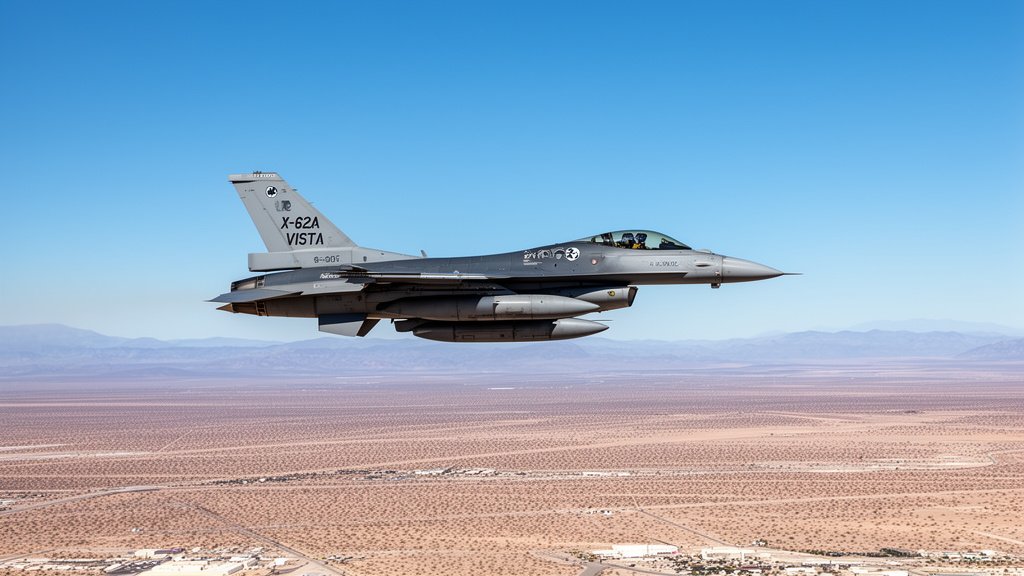
In a monumental milestone for modern defense technology, the U.S. Defense Advanced Research Projects Agency (DARPA) has successfully conducted the first real-world flight of an F-16 fighter jet controlled entirely by artificial intelligence. This historic achievement, carried out using the X-62A VISTA (Variable In-flight Simulator Test Aircraft) platform, demonstrates the viability of high-speed, autonomous aerial combat capabilities. The flight serves as a critical proof-of-concept for the Air Combat Evolution (ACE) program, proving that AI can maneuver a high-performance jet with the precision, speed, and strategic awareness previously reserved for human pilots.
Key Highlights
- The Platform: The flight utilized the X-62A VISTA, a heavily modified F-16 designed to simulate the flight characteristics of other aircraft.
- The Program: This test is a foundational success for DARPA’s Air Combat Evolution (ACE) initiative, which aims to increase trust in autonomous systems for combat scenarios.
- The Tech: The flight successfully integrated the VENOM Autonomy Kit, a sophisticated software suite enabling the jet to operate autonomously while maintaining human-in-the-loop override capabilities.
- The Location: The operations were conducted at the historic Edwards Air Force Base in California, a central hub for U.S. aerospace research and testing.
The Dawn of Algorithmic Aerial Dominance
The success of the X-62A VISTA flight is not merely a technical triumph; it is a fundamental shift in how the Department of Defense envisions the future of air superiority. For decades, the concept of a pilotless fighter jet was confined to science fiction and restricted simulations. However, DARPA’s ACE program has bridged the gap between virtual training environments and the physical unpredictability of the sky.
Decoding the ACE Program
At its core, the ACE program seeks to foster trust in autonomous AI systems. The primary goal is not to remove the pilot entirely, but to create a tactical partnership where the machine handles the complex, high-G calculations and split-second tactical decisions, allowing the human pilot to focus on broader strategic objectives. By utilizing the X-62A VISTA as a flying laboratory, engineers have been able to subject machine-learning algorithms to real-world flight conditions. Unlike flight simulators, which often fail to replicate the chaotic turbulence and sensor degradation of actual flight, the X-62A forces the AI to adapt to physical reality in real-time.
The Mechanics of Machine Pilotage
The flight control software powering the F-16 represents a leap in neural network sophistication. The system must synthesize massive amounts of data from onboard sensors—radar, infrared, and telemetry—to make decisions within milliseconds. During the recent flight, the autonomous controller successfully engaged in complex maneuvers that tested the boundaries of the aircraft’s envelope. The VENOM Autonomy Kit acts as the interface between these high-level AI decisions and the physical flight control surfaces, ensuring the aircraft responds with the precision required for dogfighting while respecting safety constraints established by human engineers.
Moving Beyond Simulation
Previous iterations of the ACE program relied heavily on simulated dogfights, where algorithms ‘learned’ to fly against each other. While these simulations yielded highly efficient pilots, they left a critical gap: hardware reliability. The real-world flight at Edwards Air Force Base validated that the algorithms could effectively command a physical asset in an uncontrolled environment. This transition from ‘digital pilot’ to ‘physical pilot’ is the single most significant hurdle in the deployment of autonomous systems in any military branch. By proving the software could handle the latent delays and physical stresses of real flight, DARPA has effectively cleared the path for the integration of AI into operational tactical jets.
Safety and The ‘Human-in-the-Loop’ Protocol
Ethical and safety considerations have been the bedrock of the ACE project since its inception. DARPA has emphasized that the autonomy kit is designed with multiple fail-safes. Human pilots were onboard the X-62A during this test flight, serving as safety monitors capable of overriding the AI at any moment. This ‘human-in-the-loop’ architecture ensures that machines operate within strict boundaries of engagement. The current doctrine focuses on autonomy as a force multiplier—an intelligent wingman—rather than an autonomous agent capable of initiating lethal force without supervision. This approach addresses long-standing congressional and public concerns regarding the deployment of ‘killer robots,’ framing the technology instead as a tool for increased safety and tactical efficiency.
The Future of Aerial Warfare
The implications for future procurement and strategy are profound. As the U.S. Air Force looks to transition toward fleets of collaborative combat aircraft (CCA), this test provides the blueprint for how those systems will fly. A fleet of autonomous drones, capable of mimicking the evasive maneuvers and offensive aggression of an F-16, could fundamentally alter the cost-benefit analysis of aerial warfare. If machines can perform the most dangerous maneuvers, the risk to human aircrews is dramatically reduced, and the strategic possibilities for multi-vector attacks are multiplied.
FAQ: People Also Ask
1. Was the aircraft completely pilotless during the test?
No. While the F-16 was controlled entirely by AI, there were human safety pilots onboard the X-62A VISTA. Their role was to monitor the system and intervene if the AI performed outside of pre-programmed safety parameters.
2. What is the difference between VENOM and the X-62A?
The X-62A VISTA is the specific aircraft platform—a modified F-16 designed for testing. The VENOM Autonomy Kit is the software/hardware system, or ‘the brain,’ installed on the aircraft to enable the AI control.
3. Will this technology replace human pilots?
DARPA and the Air Force maintain that the goal is partnership, not replacement. The objective is to leverage AI for tasks that require faster processing than a human brain can manage, specifically in high-G combat maneuvers, thereby acting as a force multiplier for human aircrews.


Related Posts