Fujitsu’s Kozuchi Physical AI 1.0: Merging Intelligent Agents and Physical Robots
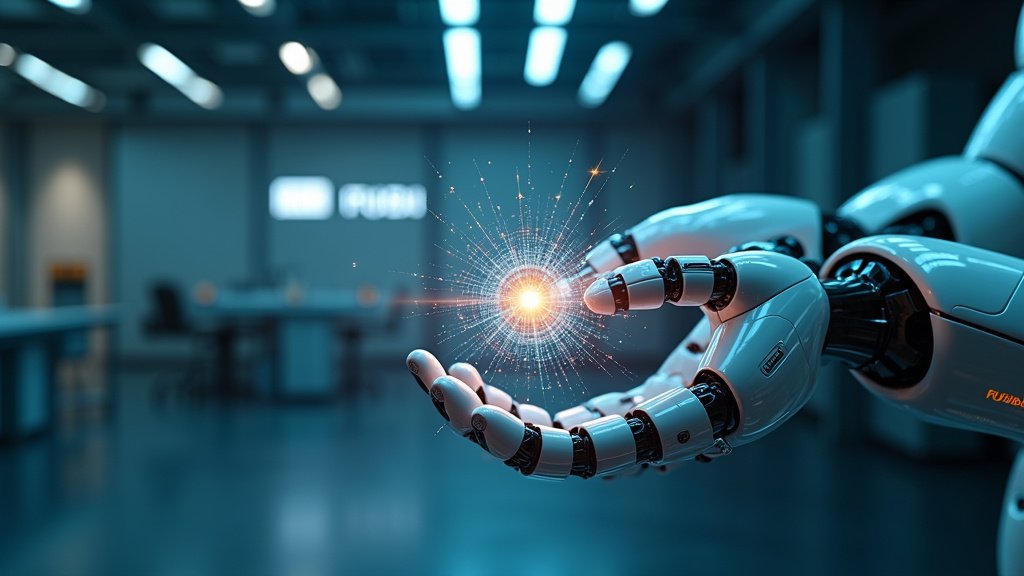
Fujitsu has unveiled a groundbreaking new technology: Physical AI. This marks a significant step forward, seamlessly integrating physical robots with intelligent AI agents. This recent development, stemming from a collaboration with NVIDIA, aims to redefine how AI interacts with the real world, fostering enhanced human-AI and robot-AI collaboration. Fujitsu envisions a future where Physical AI capabilities redefine interactions, highlighting a major advancement in AI potential.
Fujitsu NVIDIA Partnership: A Foundation for Physical AI
Fujitsu partnered with NVIDIA, announcing their collaboration on October 3, 2025. This integration leverages NVIDIA’s software stack alongside Fujitsu’s proprietary technologies. Key components include NVIDIA NIM microservices, Fujitsu’s Kozuchi AI platform, NVIDIA Dynamo, NeMo, and Fujitsu’s Takane LLM. This powerful full-stack AI infrastructure, crucial for developing Physical AI, accelerates AI adoption across many industries. This featured alliance is crucial for their ambitious goals in achieving robust Physical AI.
Bridging the Physical and Digital with Physical AI
Kozuchi Physical AI 1.0 aims to solve existing AI limitations. While agentic AI can learn and act autonomously, applying this to the physical world presented challenges. This physical AI technology enables AI agents to interact directly with physical robots, allowing AI to understand and operate in real-world environments. Fujitsu plans to evolve this into an agentic AI foundation by the end of fiscal year 2025. AI agents will autonomously learn and evolve within customer settings, allowing for seamless integration into physical operations. This recent advancement is key to this vision of advanced Physical AI.
Core Capabilities and Vision for Physical AI
The new technology offers several core functions, including a multi-AI agent framework that enables secure automation of confidential business workflows. Specialized AI agents based on Fujitsu’s Takane LLM support procurement operations, with a proof-of-concept showing a workload reduction of approximately 50%. NVIDIA NIM compatibility is expected to boost inference speed by 50%, significantly speeding up complex tasks. Fujitsu’s Spatial World Model is also part of this effort, allowing Physical AI to understand entire environments and predict human intentions. Thus, AI agents and robots can collaborate naturally, achieving a society where intelligent agents robots work together seamlessly. This featured capability of Physical AI aims for a society where AI agents and robots work together seamlessly. This news also points to plans to evolve the technology for sovereign domains.
Future Implications and Goals for Physical AI Technology
Fujitsu’s vision extends beyond just software, involving AI agents directly controlling physical robots. This opens possibilities for automation in factories and warehouses and could address labor shortages in various sectors. The physical AI technology also emphasizes secure collaboration, with Fujitsu’s secure inter-agent gateway protecting corporate data. This is vital when multiple AI agents interact. The company aims for AI agents and robots to perform complex tasks together with a deep understanding of real-world operations. Fujitsu plans to showcase its Physical AI technology at CES 2026. This initiative supports Fujitsu’s broader goal to become a technology company that realizes a net positive impact. This vision is central to their future strategy for Physical AI.
Embracing Agentic AI and Physical AI Integration
This recent development aligns with the growing trend of agentic AI. AI agents are becoming more autonomous, making decisions and executing tasks independently. Fujitsu sees AI as a trusted partner that augments human potential. This featured physical AI integration promises to unlock new possibilities and drive business transformation, further supporting societal advancements. Fujitsu continues to invest heavily in AI research, ensuring they remain at the forefront of innovation in Physical AI. This is a significant piece of news for the AI landscape, especially concerning intelligent agents robots.


Related Posts