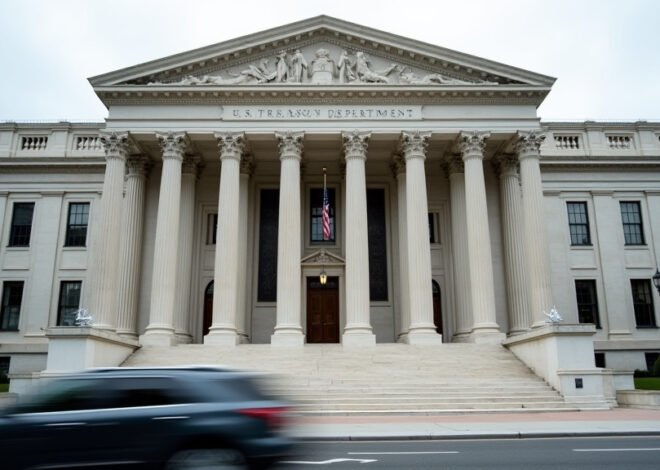
Federal Reserve Eyes Bank Holding Company Applications Amidst NYSE Fee Adjustments and Global Financial News
The Federal Reserve System has published key notices detailing bank holding company applications and proposed rule changes, signaling significant developments for the financial sector and impacting business operations. This recent financial regulation news provides crucial insights into the evolving landscape for institutions, particularly concerning the oversight of a Bank Holding Company.
Federal Reserve Bank Holding Company Actions
The Federal Reserve System is actively reviewing applications from entities seeking to establish or acquire banks, underscoring the rigorous process a Bank Holding Company must navigate. These applications are processed under the Bank Holding Company Act, and their approval is fundamental to financial consolidation and the shaping of the banking landscape. The Fed’s decisions significantly influence market structure and capital deployment, highlighting the importance of regulatory oversight for financial stability. Details of these Bank Holding Company applications are publicly accessible, with the Federal Reserve Bank of Philadelphia and other regional Federal Reserve Banks handling these crucial filings. Notably, the Federal Reserve announced the approval for PNC Financial Services Group, Inc. to acquire FirstBank Holding Company on December 11, 2025, a significant move for the Bank Holding Company sector.
NYSE Proposes Fee Rule Changes
Separately, the New York Stock Exchange LLC has proposed a rule change impacting its Listed Company Manual concerning annual fees for listed companies. The NYSE attributes these proposed NYSE fee changes to rising costs for regulatory activities and increased expenses for services such as educational programs and improved conference facilities. The intended amendments to annual fees for equity issuers, effective January 1, 2026, will see a slight increase in the per-share annual fee for common and preferred shares from $0.001285 to $0.001310, and a rise in the minimum annual fee from $82,000 to $84,000 per year. The NYSE views these adjustments as reasonable, reflecting increased operational costs and service enhancements, and these adjustments were filed with the SEC. Earlier in 2025, the NYSE also adjusted listing fees, effective January 1, 2025.
Global Financial Trends: Payment Fraud and Immigration
Further illuminating global financial trends, a Bank Policy Institute report addresses payment fraud, revealing that in 2024, fraud across the European Economic Area (EEA) reached €4.2 billion, a 17% increase from 2023. Authorized push payment (APP) scams are a major contributor, involving tricking individuals into making payments. Credit transfers incurred the highest losses at €2.5 billion, while card payments accounted for €1.3 billion. The report confirms that Strong Customer Authentication (SCA) aids in fraud reduction, yet the emergence of new fraud types necessitates the development of novel mitigation strategies, a challenge faced by every Bank Holding Company.
Canada’s Start-Up Business Class Changes
Canada’s immigration department has announced adjustments to the Start-Up Business Class, with new ministerial instructions effective January 1, 2026. To address inventory pressures, the department will accept zero new applications for processing. Existing commitment certificates from 2025 must be submitted by June 30, 2026. The program paused new applications as of December 19, 2025. Previously, caps were imposed, limiting each designated organization to supporting only 10 startups annually. These changes aim to resolve backlogs and enhance processing efficiency, reflecting significant quota reductions for 2025 and expected further decreases for 2026 and 2027, as part of broader immigration reforms in Canada. This contrasts with the growth-oriented outlook for a Bank Holding Company in other regions.
Regulatory Environment Evolution for Bank Holding Companies
Recent regulatory actions are also significantly impacting large bank holding companies. The Federal Reserve Board has finalized revisions to its supervisory rating framework specifically for large bank holding companies, aiming for more precise assessments of their financial strength and alignment with other supervisory systems. Furthermore, the Federal Reserve has finalized a rule concerning the enhanced Supplementary Leverage Ratio (eSLR), recalibrating it for U.S. global systemically important bank holding companies (GSIBs) with the objective of simplifying leverage limits and fostering customer service. These proactive measures by regulatory bodies, including obtaining necessary Federal Reserve applications, are shaping the future of financial regulation and underscoring a dynamic environment for every Bank Holding Company.


Related Posts