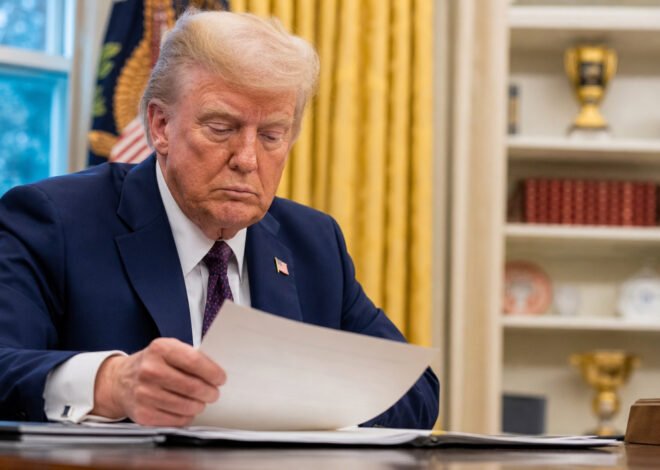
Trump Slaps 25% Tariff on EU Autos in Trade Showdown
President Donald Trump announced on Friday that the United States will hike tariffs on cars and trucks imported from the European Union to 25% starting next week. The move marks a dramatic reversal of the 15% rate established under the bilateral trade framework known as the Turnberry Agreement, finalized last summer. The President, communicating via Truth Social, accused the European bloc of failing to comply with specific, fully agreed-upon terms, though he stopped short of detailing the precise nature of the alleged violations. The announcement has immediately sent global markets into a defensive stance, signaling a new era of volatility for transatlantic trade relations.
Key Highlights
- Tariff Hike: Tariffs on EU-imported cars and trucks are set to rise to 25% effective next week.
- Exemption Policy: Vehicles produced by European automakers within U.S.-based plants are explicitly exempt from the new duties.
- The Compliance Dispute: The White House justifies the move by citing a failure of the European Union to adhere to the 2025 Turnberry Agreement.
- Economic Tension: This escalation creates immediate uncertainty for global supply chains and risks retaliatory measures from Brussels.
The Turnberry Breakdown: Transatlantic Trade at a Crossroads
The announcement of a 25% tariff on European automobile imports represents the most significant shift in U.S.-EU economic policy since the implementation of the Turnberry Agreement last year. Designed to stabilize trade after years of friction, that framework had successfully lowered the tariff ceiling on goods to 15%. By unilaterally restoring the 25% level—a rate originally utilized under Section 232 national security authorities—the Trump administration is effectively abandoning the collaborative structure that had defined transatlantic economic relations for the past several months.
The Mechanics of the Escalation
The pivot is rooted in what the administration describes as a fundamental lack of compliance from European officials. While the President’s statement lacked granular detail regarding the specific technical failures of the European Commission, the administration has long complained about barriers to U.S. agricultural and industrial exports. European officials, conversely, have maintained that they have upheld their side of the bargain, arguing that the legislative delays in the European Parliament regarding zero-tariff regulations on American goods were due to procedural complexities, not a desire to subvert the agreement.
Legal analysts are watching the move closely, particularly given the Supreme Court’s ruling earlier this year, which curtailed the President’s authority to declare economic emergencies solely for the purpose of imposing tariffs. By framing this new round of duties under Section 232 of the Trade Expansion Act of 1962—the same authority used for the initial national security tariffs in 2025—the administration is attempting to insulate the policy from further judicial invalidation. This approach provides a firmer, albeit still contentious, legal footing compared to previous efforts that relied on the International Emergency Economic Powers Act (IEEPA).
Supply Chains and the ‘Made in USA’ Incentive
A critical component of the President’s announcement was the explicit carve-out for vehicles manufactured in American plants. By declaring that “if they produce Cars and Trucks in U.S.A. Plants, there will be NO TARIFF,” the administration is doubling down on its economic nationalism agenda. The goal is clear: to force European manufacturers—who have historically maintained heavy import volumes—to accelerate capital expenditure and infrastructure development within the United States.
Industry experts warn, however, that this is a blunt instrument. Complex supply chains do not pivot on a dime. Even if an automaker aims to comply, the lead time to construct or expand U.S. manufacturing facilities is years, not weeks. The immediate result of this 25% hike will likely be a surge in costs for the American consumer or a significant margin squeeze for European brands like Volkswagen, Mercedes-Benz, and BMW. As companies grapple with these added costs, there is a legitimate concern that domestic auto production will face its own inflationary pressures as component costs rise alongside finished vehicle prices.
Geopolitical Ripples and Future Projections
The diplomatic fallout is likely to be swift. Brussels has previously signaled a zero-tolerance approach to unilateral U.S. tariff hikes, and European trade commissioners are already reportedly in emergency consultations to discuss retaliatory measures. This creates a high-stakes “tit-for-tat” scenario. Historically, trade wars between the U.S. and the EU result in targeted tariffs against American agricultural products, luxury goods, and whiskey—politically sensitive industries that the EU targets to maximize domestic U.S. pressure on the White House.
Looking forward, the stability of the entire Transatlantic Trade and Investment framework is now in doubt. If the 25% tariff takes effect next week as planned, it will likely mark the functional end of the Turnberry Agreement. The question remains whether this is a tactical negotiation ploy intended to force Brussels back to the table with concessions, or the beginning of a sustained protectionist strategy that fundamentally alters the nature of the Western alliance’s economic cooperation. For global investors and corporate strategists, the coming week will be defined by contingency planning and a frantic search for clarity from Washington.
FAQ: People Also Ask
1. Why is the U.S. raising tariffs on EU autos now?
The Trump administration claims the European Union is not complying with the 2025 Turnberry Agreement. While specific details of the non-compliance were not listed in the President’s announcement, the administration has long cited issues regarding trade imbalances and the failure of the EU to fully enact zero-tariff regulations on U.S. goods.
2. Will this affect cars made by European companies in the U.S.?
No. The administration stated that any vehicles produced at U.S.-based plants are exempt from the 25% tariff. This policy is explicitly designed to incentivize European automakers to increase their manufacturing footprint within the United States.
3. Is there a legal challenge expected against this tariff?
The administration is leveraging Section 232 of the Trade Expansion Act of 1962 to justify these tariffs as a national security measure. This differs from past attempts that relied on the International Emergency Economic Powers Act, which faced recent Supreme Court pushback, suggesting the administration is seeking to avoid similar legal vulnerabilities.
4. How will the EU respond?
While official responses are pending, previous trade disputes suggest the European Union may prepare a list of retaliatory tariffs targeting U.S. exports. Officials in Brussels have previously stated that they expect the U.S. to honor its commitments, suggesting that a diplomatic confrontation is highly likely.


Related Posts