Trump-Xi Summit: Navigating Global AI and Iran Tensions
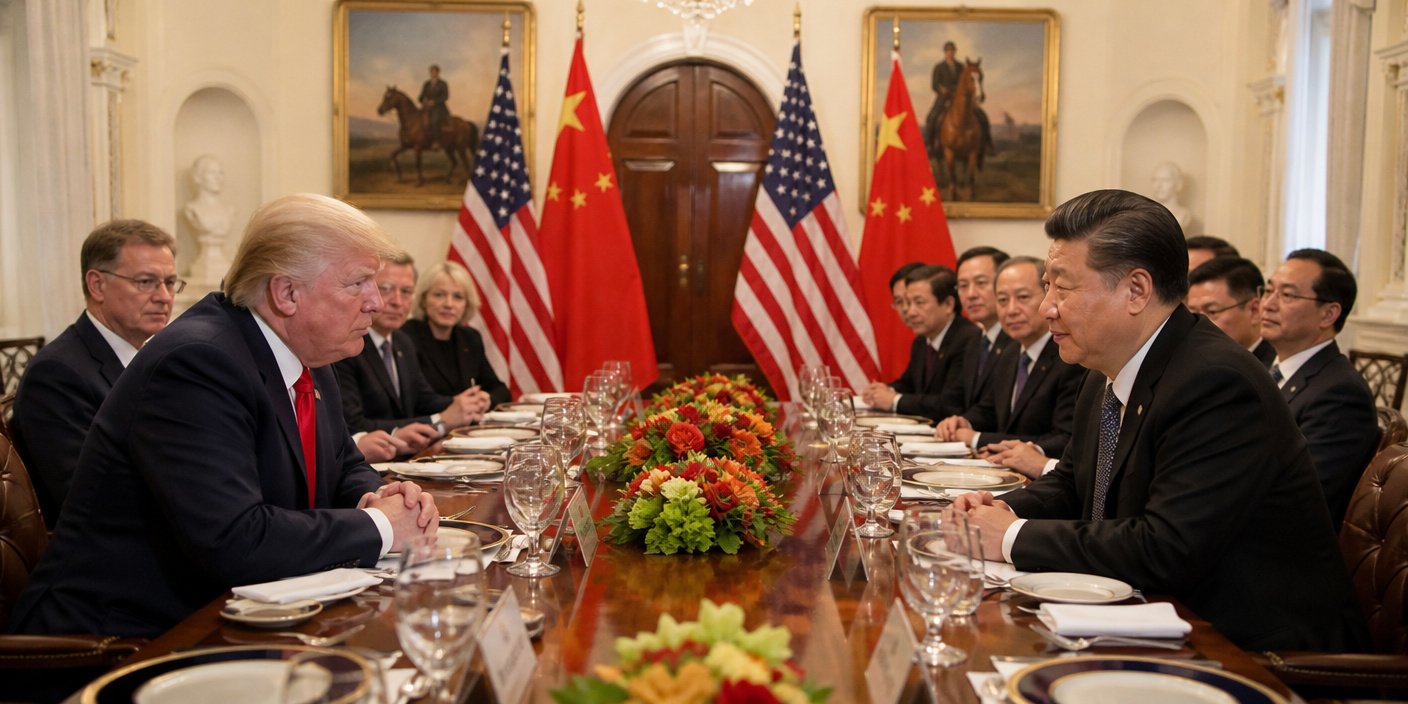
On September 23, 2026, the White House became the stage for a critical diplomatic summit as President Donald Trump hosted Chinese President Xi Jinping. This high-stakes meeting represents a significant inflection point in 21st-century international relations, bringing together the world’s two largest economies to address two of the most pressing challenges of the era: the destabilizing conflict involving Iran and the rapid, often chaotic, evolution of artificial intelligence.
Key Highlights
- Summit Date & Location: The summit took place on September 23, 2026, at the White House, marking a key moment in US-China relations.
- Core Agenda: The discussions were explicitly focused on cooling regional tensions in the Middle East, specifically regarding Iran, and establishing guardrails for global AI development.
- Strategic Objective: Both administrations sought to create a framework for “managed competition,” aiming to prevent technological or regional escalations from spiraling into direct confrontation.
Strategic Realignment: The 2026 White House Summit
The September 23, 2026, meeting between President Trump and President Xi Jinping arrives at a juncture where the traditional geopolitical order is being rewritten by both kinetic conflict and algorithmic advancement. The White House summit was characterized by a push to separate areas of acute friction from areas where mutual interest necessitates cooperation. As the two leaders met in Washington, the global community watched closely to see if the two powers could move beyond the zero-sum dynamics that have defined the previous decade.
The Iran Question: Seeking Stability in a Volatile Region
Perhaps the most pressing item on the agenda was the ongoing conflict involving Iran. With regional instability reaching a boiling point throughout 2026, the White House has increasingly sought to leverage diplomatic channels with Beijing to exert influence over Tehran. The discussion centered on the flow of energy resources, supply chain continuity, and the necessity of preventing a broader regional conflagration that would jeopardize global economic recovery.
Analysts suggest that the administration’s strategy relies on the fact that China, as a major purchaser of Iranian energy, possesses unique leverage. By aligning, even partially, on the goal of regional de-escalation, the two leaders aimed to create a ‘stability corridor’ that protects critical maritime trade routes. This section of the talks was reportedly dominated by logistical concerns and a shared desire to insulate the global economy from further shocks originating in the Middle East.
Decoding the AI Accord: From Competition to Safety
While regional security provided the immediate context for the summit, the long-term focus was undeniably on artificial intelligence. The rapid integration of AI into military and economic infrastructure has created a new ‘arms race’ dynamic. The 2026 summit marked a rare instance where both parties openly discussed the parameters for safe development. The dialogue focused on identifying the specific ‘red lines’ in AI deployment—such as the automation of nuclear command-and-control systems and the potential for deep-learning models to destabilize financial markets.
Both the Department of State and the corresponding Chinese delegations have been under immense pressure from the private sector to clarify regulatory expectations. By beginning to outline shared protocols for AI testing and transparency, the two leaders hope to prevent a runaway scenario where technological integration outpaces regulatory oversight. The ambition here is not necessarily convergence in philosophy, but rather the establishment of ‘technical interoperability’ to manage risks.
Economic and Geopolitical Implications for 2026
Beyond the headline topics, the summit signals a potential thaw in the rigid, antagonistic stance that has characterized US-China relations. Economic markets reacted with cautious optimism as the summit concluded, interpreting the face-to-face meeting as a mechanism to lower the probability of catastrophic “black swan” events.
However, the path forward remains complex. The secondary effects of this summit will likely ripple through global supply chains for months to come. If the White House and Beijing can successfully operationalize the agreements made regarding AI oversight, it could create a blueprint for international governance in the digital age. Conversely, if these discussions fail to produce concrete, verifiable actions, the resulting loss of credibility could lead to a swift re-escalation of trade barriers and technological decoupling.
Ultimately, this summit was not about resolving every grievance; it was about defining the rules of the game for a multipolar world. As both leaders departed, the underlying message was clear: in 2026, the cost of total miscommunication is simply too high for either nation to bear.
FAQ: People Also Ask
Q: Why was the September 23, 2026, summit considered so high-stakes?
A: The summit addressed the intersection of an active, volatile regional conflict in the Middle East and the existential risks posed by unregulated AI development, making it one of the most critical diplomatic events of the year.
Q: Did the summit result in a formal treaty?
A: While the White House has not released a binding treaty, the meeting established a series of high-level working groups intended to formalize protocols for AI safety and regional de-escalation.
Q: How does the conflict with Iran affect US-China trade?
A: Iran’s role in global energy markets means that any escalation creates volatility in oil and gas prices. The US and China share an interest in maintaining stable energy flows, which has become a primary driver of their recent diplomatic cooperation.


Related Posts