
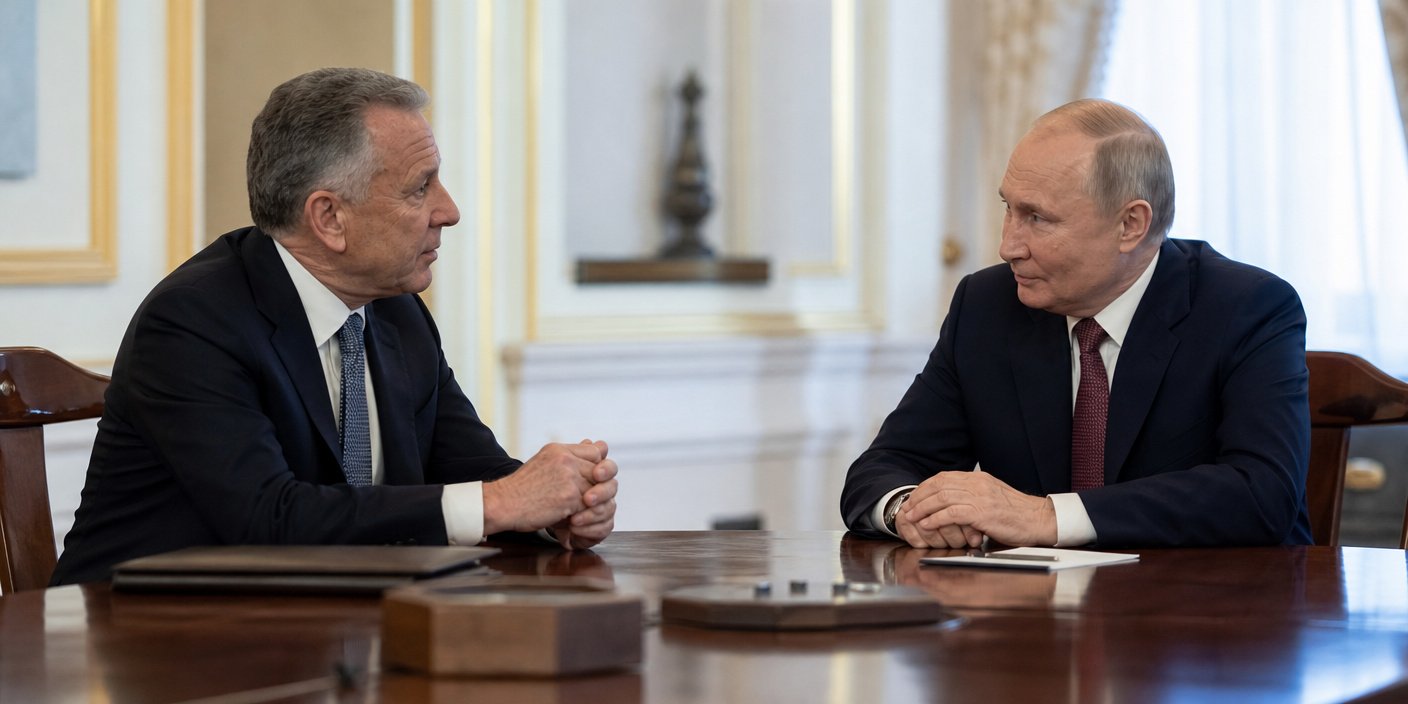
Putin Agrees to Resume Trilateral Ukraine Talks
Russian President Vladimir Putin has signaled a significant shift in diplomatic posture, confirming his agreement to resume trilateral negotiations regarding the ongoing conflict in Ukraine. This development follows high-stakes discussions in St. Petersburg between Putin and Steve Witkoff, the special envoy appointed by U.S. President Donald Trump, marking a potentially pivotal moment in international efforts to stabilize the region.
Key Highlights
- Vladimir Putin has formally agreed to resume trilateral talks regarding the Ukraine war, directly involving representatives from Kyiv and Washington.
- The decision follows critical high-level meetings held in St. Petersburg between Putin and Steve Witkoff, President Trump’s designated special envoy.
- The renewed trilateral framework signifies a shift in the U.S. approach to the conflict, prioritizing direct engagement between the key stakeholders.
- While details on the specific terms remain under wraps, the agreement indicates a potential thaw in communication channels that have been largely paralyzed for months.
The New Diplomatic Architecture: Trilateral Talks
The announcement that Vladimir Putin has agreed to resume trilateral talks represents a fundamental recalibration of the diplomatic chessboard regarding the Ukraine war. For much of the recent duration of the conflict, international mediation has been fragmented, often occurring through secondary European entities or indirect channels. By formalizing a trilateral format that includes Moscow, Kyiv, and Washington, the administration of U.S. President Donald Trump is attempting to bypass established bottlenecks and engage the primary belligerents directly.
The St. Petersburg Catalyst
The groundwork for this breakthrough was laid in St. Petersburg, where Steve Witkoff, acting as the special envoy for President Trump, engaged in high-level discussions with the Russian leadership. Witkoff’s involvement as a direct representative highlights the Trump administration’s preference for personal, transactional diplomacy. The choice of St. Petersburg as the venue for these meetings holds symbolic weight, as it is a city deeply intertwined with Russian history and Putin’s own political origins. The discussions reportedly moved past the initial rhetoric that has characterized U.S.-Russia relations for the past three years, focusing instead on the logistics of re-establishing a reliable line of communication.
The Shift from Multilateral to Bilateral-Plus
Historically, negotiations concerning the Ukraine conflict have often involved a broader array of stakeholders, including the European Union, the OSCE, and various G7 partners. This multilateral approach, while theoretically inclusive, often led to institutional paralysis. The move toward a trilateral format—Russia, Ukraine, and the United States—suggests that the Trump administration views the conflict primarily as a bilateral matter between Moscow and Kyiv, with Washington acting as the essential third-party guarantor. This structure empowers the U.S. to exert more direct pressure on both sides to reach a ceasefire or a long-term territorial settlement. However, it also raises questions regarding the agency of the Kyiv government and the degree to which Ukraine will be able to dictate its own terms within this concentrated negotiation framework.
Geopolitical Implications and Regional Stability
The agreement to talk does not immediately equate to a peace deal. The fundamental disagreements—specifically regarding border demarcations, security guarantees, and NATO alignment—remain unresolved. Yet, the existence of a formal, high-level channel is the prerequisite for any de-escalation. By securing Putin’s consent for this trilateral format, the White House has cleared the first hurdle toward a potential off-ramp. Markets, which have been sensitized to the volatility of the Ukraine war, may react cautiously, looking for tangible outcomes rather than just the commencement of the talks themselves. The economic impact of a sustained diplomatic effort could lead to a stabilization of energy markets and a reduction in the risk premiums currently priced into European infrastructure assets.
Challenges Ahead: Building Trust from Zero
One of the most significant challenges facing this new trilateral initiative is the total absence of trust. Years of conflict have eroded the foundational belief that agreements will be honored. Steve Witkoff, as the architect of this channel, faces the daunting task of maintaining a credible, neutral mediation stance while representing the interests of a U.S. administration that has clear objectives regarding geopolitical leverage. Whether this process can evolve into a robust peace process or if it will be limited to short-term de-confliction measures remains the defining question of this diplomatic pivot.
FAQ: People Also Ask
1. Who is Steve Witkoff and why is he leading these talks?
Steve Witkoff is a real estate developer and businessman who was appointed by President Donald Trump as a special envoy. His role is to serve as a personal, high-level channel between the U.S. President and his Russian counterparts, bypassing traditional State Department bureaucracy to facilitate direct negotiation.
2. What is the significance of “trilateral” talks in this context?
Trilateral talks involving Kyiv, Washington, and Moscow remove the complexity of broader multilateral formats. It allows for a more focused, rapid negotiation process where the U.S. can exert direct influence, theoretically speeding up the possibility of reaching a ceasefire or diplomatic breakthrough.
3. Does this mean the war is ending soon?
Not necessarily. While the agreement to resume talks is a necessary first step toward peace, it is not a peace treaty itself. The parties remain deeply divided on core issues. These talks are a mechanism for communication, but the success of the outcome depends entirely on the willingness of all three parties to compromise on non-negotiable positions.


Related Posts


