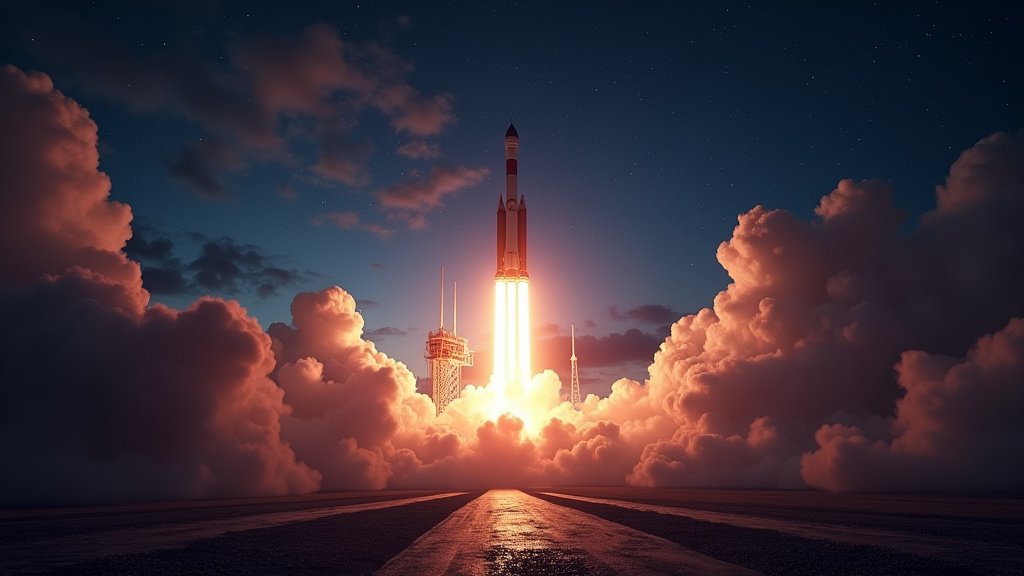
Artemis II Launch: NASA Rockets Back to the Moon
The dawn of a new era in human space exploration broke over the Florida coast today as NASA’s Artemis II mission successfully launched, beginning a historic voyage that will carry four astronauts into the vicinity of the Moon. This landmark achievement represents the culmination of years of rigorous testing, engineering refinement, and international collaboration. As the Space Launch System (SLS) rocket ignited, it not only propelled the Orion spacecraft into orbit but also reignited the global ambition to establish a sustained human presence beyond low-Earth orbit. This mission serves as a critical bridge between the foundational achievements of the Apollo era and the sustainable, long-term lunar objectives defined by the Artemis program.
The Engineering Marvel of the Artemis II Launch
The technological prowess required to execute this mission cannot be overstated. The SLS rocket, the most powerful vehicle ever developed by NASA, demonstrated flawless performance during the critical first stage of flight. Engineers focused heavily on the integration of the launch vehicle with the Orion spacecraft, ensuring that the life support systems, navigation, and emergency abort capabilities met the stringent safety requirements necessary for human passengers. The successful ignition and subsequent stage separation provided a vital data set for mission control, confirming that the hardware is prepared for the complex maneuvers required to transition from Earth orbit to a lunar trajectory. This technical victory provides a massive boost to the reliability of NASA’s next-generation deep-space transport systems.
Crew Dynamics and Scientific Objectives
The four astronauts aboard Orion—a diverse crew representing NASA and the Canadian Space Agency—are tasked with a rigorous flight test profile. Unlike the landing missions of the past, Artemis II is designed to test the limits of the Orion spacecraft in deep space. Throughout the mission, the crew will perform manual flying maneuvers, evaluate life support, and test deep-space communication systems, providing critical telemetry that will inform the design of future landers and surface habitats. The scientific payload includes advanced instrumentation designed to measure the radiation environment, a key factor in ensuring the safety of future, longer-duration missions to the lunar surface and, eventually, Mars. The successful launch has set the stage for these experimental phases, with the crew already reporting nominal system performance as they begin their transit.
Strategic Implications for Lunar Colonization
Beyond the immediate thrill of the launch, the Artemis II mission is a cornerstone of the broader Artemis strategy. By demonstrating that humanity can consistently return to the Moon with modern technology, NASA is laying the groundwork for the Lunar Gateway—a proposed orbiting station that will facilitate easier surface access. This mission effectively transitions the Moon from a destination for short-term visitation to a platform for scientific discovery and economic expansion. International partners are watching closely, as the success of Artemis II solidifies the viability of cooperative space endeavors. The mission underscores a pivot in aerospace strategy, moving away from reactive, single-goal missions toward a proactive, multi-layered architecture designed for sustainability and scalability. As the spacecraft continues its journey, the global space community views this launch as the definitive ‘go’ signal for the next phase of human history in the solar system.
FAQ: People Also Ask
Q: Will the Artemis II astronauts land on the Moon?
A: No, the Artemis II mission is a crewed flight test that will orbit the Moon and return to Earth. It does not include a lunar landing. The first landing with astronauts is planned for the Artemis III mission.
Q: How many astronauts are on the Artemis II mission?
A: There are four astronauts on the mission: NASA astronauts Reid Wiseman, Victor Glover, and Christina Koch, and Canadian Space Agency astronaut Jeremy Hansen.
Q: Why is the Artemis II mission considered so important?
A: Artemis II is the first time humans have flown in the vicinity of the Moon since the Apollo 17 mission in 1972. It is a critical flight test that validates the life support and navigation systems required for long-term human exploration of deep space.


Related Posts