Maduro in U.S. Court: Capture Sparks Global Outcry and Legal Storm
The recent appearance of Nicolás Maduro in a **Maduro U.S. Court** on January 5, 2026, marks a pivotal moment. This event follows his capture by U.S. forces and has triggered significant international reactions, reshaping discussions on U.S. foreign policy and leaving many watching Venezuela’s future closely. The **Maduro U.S. Court** proceedings are now a focal point of global attention.
Maduro Enters U.S. Courtroom: A Historic Appearance
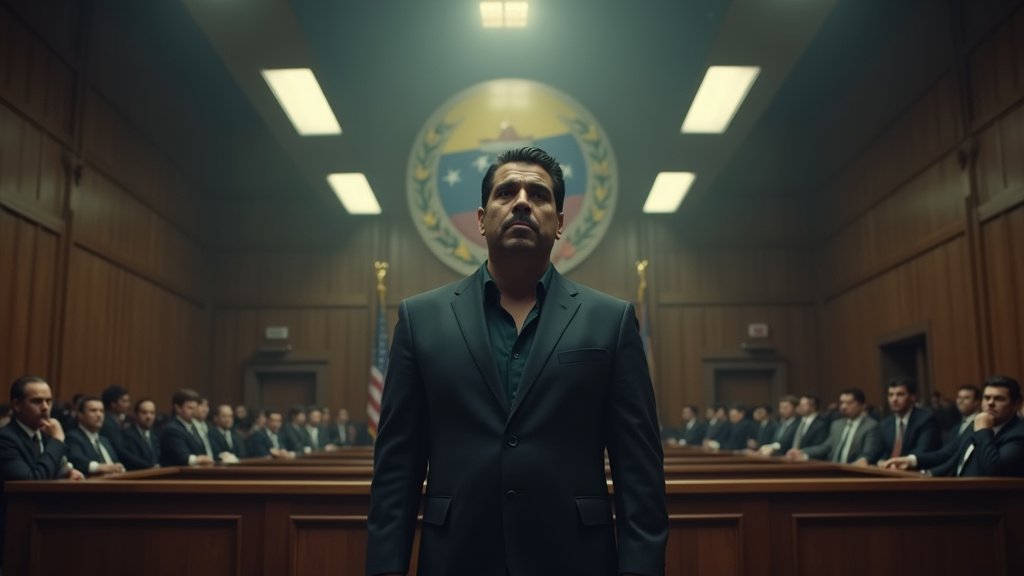
Maduro stood before a judge in New York for his **Maduro U.S. Court** appearance. He pleaded not guilty to federal charges, proclaiming his innocence and calling himself a “prisoner of war.” His wife, Cilia Flores, also entered a not guilty plea, asserting her complete innocence. The initial hearing, a crucial step in the **Maduro U.S. Court** process, lasted approximately 30 minutes, with a follow-up date set for March 17, indicating a lengthy legal battle ahead.
The Capture and Narco-terrorism Charges in a U.S. Court
The capture of Maduro occurred on January 3, 2026, during “Operation Absolute Resolve.” U.S. military forces transported Maduro and his wife to New York, where they now face narco-terrorism charges in a **Maduro U.S. Court**. These charges, along with drug trafficking and conspiracy accusations, carry severe penalties, highlighting the gravity of the allegations presented in the U.S. indictment. The U.S. claims Maduro led a widespread narco-terrorism conspiracy, a central theme of the upcoming **Maduro U.S. Court** proceedings.
Global Reaction and Legal Debates Surrounding the Maduro U.S. Court Case
The U.S. intervention and the subsequent **Maduro U.S. Court** case have sparked widespread international concern. The UN Security Council convened an emergency meeting, with many nations condemning the U.S. action as a violation of international law and national sovereignty. Russia decried it as a “turn back to the era of lawlessness,” while China labeled it a “blatant use of force.” The UN Secretary-General expressed deep concern, emphasizing that international law rules were not respected, a sentiment echoed by some U.S. allies who called for adherence to the rule of law. Venezuela’s representative decried the action as an “illegitimate armed attack,” setting the stage for complex legal arguments in the **Maduro U.S. Court**.
U.S. Policy Shift and Venezuela’s Future in Light of the Maduro U.S. Court Action
President Trump’s assertion that the U.S. is “in charge” of Venezuela and intends to “run the country” during a transition signifies a major pivot in U.S. foreign policy, directly linked to the ongoing **Maduro U.S. Court** developments. While the U.S. aims to control Venezuela’s oil reserves, officials have downplayed direct governance, opting instead for an “oil quarantine.” The U.S. has a mixed record on regime change, and the future governance of Venezuela remains uncertain, though opposition leaders express hopes for a democratic transition following the **Maduro U.S. Court** appearance.
Lingering Uncertainty Amidst the Maduro U.S. Court Proceedings
Maduro’s court appearance, a significant news event stemming from the **Maduro U.S. Court** proceedings, leaves the international community grappling with profound implications. Debates over international law and national sovereignty are intensified by the U.S. assertion of its role in Venezuela’s future. This complex situation, centered around the **Maduro U.S. Court** case, promises further developments, with the path ahead for Venezuela remaining unclear and legal experts anticipating a lengthy process following this landmark **Maduro U.S. Court** action.


Related Posts