Emergency Response Underway After Tanker-Passenger Boat Collision on Mississippi River
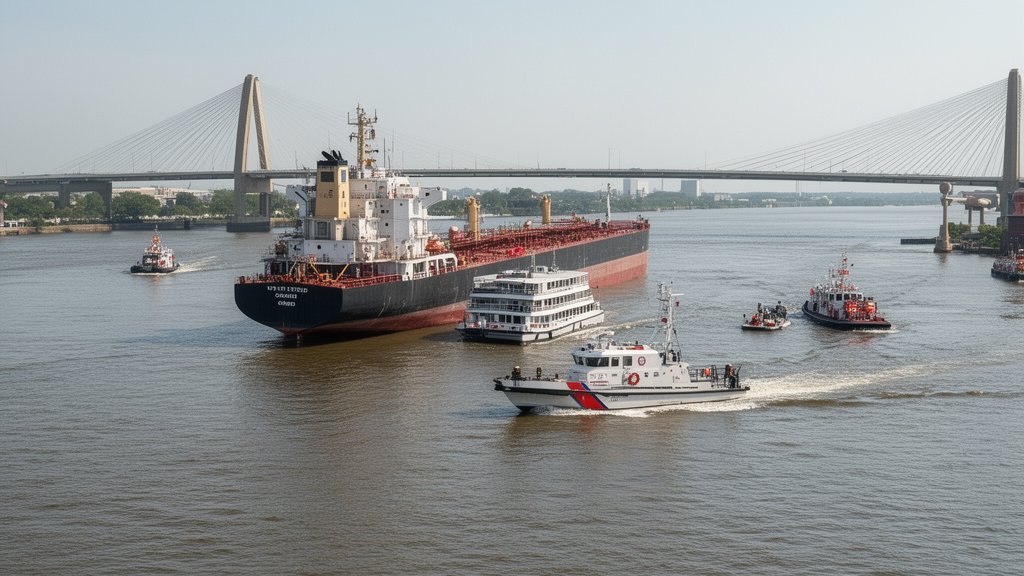
Emergency response teams are currently engaged in a critical search and rescue operation on the Mississippi River following a collision between a large tanker vessel and a passenger boat carrying 129 people. The incident occurred in the vicinity of the Crescent City Connection, a high-traffic segment of the river near New Orleans, triggering an immediate and multi-agency mobilization. While the exact cause of the collision remains under investigation, the priority remains the safety and accountability of all 129 passengers and crew members involved in this maritime emergency.
Key Highlights
- A major collision occurred today between a tanker and a passenger vessel near the Crescent City Connection on the Mississippi River.
- Initial manifests confirm 129 passengers were on board the passenger vessel at the time of the impact.
- The United States Coast Guard (USCG) Sector New Orleans is currently coordinating the active emergency response and rescue operations.
- Local emergency services and harbor police are establishing triage and recovery zones along the riverbanks to assist survivors.
Maritime Crisis: Navigating the Aftermath of the Lower Mississippi Collision
The Anatomy of the Collision
The Mississippi River serves as one of the world’s most vital and heavily trafficked waterways, acting as the primary artery for industrial and commercial logistics in the United States. The segment near the Crescent City Connection is particularly complex, characterized by tight turns, significant current variations, and intense density of mixed-use maritime traffic. When a tanker—typically a vessel of immense displacement and inertia—collides with a smaller passenger vessel, the physics of the impact are devastating. In this incident, the sheer mass of the tanker presents a significant challenge to the structural integrity of the smaller passenger craft. Initial reports suggest the collision occurred during active navigational hours, highlighting the inherent risks of shared-use river passages where recreational, commercial, and industrial vessels converge in limited navigational channels.
The USCG Response and Emergency Coordination
Upon receiving distress signals, the United States Coast Guard (USCG) Sector New Orleans immediately initiated its maritime disaster protocol. The rescue effort involves a coordinated response from multiple agencies, including the Port of New Orleans harbor police, local fire department marine units, and commercial tug operators who are uniquely positioned to provide immediate stabilization for vessels in distress. The primary focus is the extraction of the 129 passengers, many of whom required immediate medical triage. Establishing a perimeter on such a wide, flowing river is a logistical challenge; current-deflection and potential water ingress into the damaged vessel are the primary variables teams are managing as they attempt to safely transfer passengers to shore-based medical facilities.
The Role of Vessel Traffic Service (VTS)
Navigation on this stretch of the river is governed by the Vessel Traffic Service (VTS), which acts as a maritime air traffic controller. Every vessel of significant size is required to communicate with VTS to manage movement through the Crescent City Connection. A central point of the pending investigation will be the communications logs and radar telemetry recorded by VTS prior to the incident. Investigators will be looking for discrepancies in course, speed, or navigational protocols that might have led to the breakdown in separation between the tanker and the passenger boat. Understanding whether this was a mechanical failure, a miscommunication, or an error in judgment will be the cornerstone of the National Transportation Safety Board (NTSB) investigation that will inevitably follow the immediate rescue phase.
Economic and Industrial Ripple Effects
The Mississippi River is not merely a transit point; it is a critical component of the national supply chain. The closure of the river, even a partial one, to facilitate rescue operations has immediate economic consequences. Tankers and cargo ships are vital for the transport of petrochemicals, grain, and raw materials. An obstruction near the Crescent City Connection effectively acts as a bottleneck, forcing upstream and downstream traffic to halt. This delay causes a cascading economic effect, creating a backlog in the port and potentially disrupting schedules for regional infrastructure and supply lines. The duration of the river closure for the rescue operation—and the subsequent salvage operations—will determine the scale of this economic impact.
Future Implications for River Safety
As the investigation unfolds, the maritime community will once again turn its attention to the regulations governing passenger vessel proximity to industrial shipping. For years, there has been a debate regarding the ‘buffer zones’ required between passenger ferries and heavy commercial shipping. This incident raises questions about whether existing safety protocols—specifically regarding real-time warning systems on passenger vessels and the navigational limitations of large tankers in high-current zones—are sufficient for the modern intensity of river traffic. Looking forward, we may see accelerated calls for mandatory automated collision-avoidance systems (CAS) specifically tailored for river navigation, potentially forcing a redesign of how passenger manifests and traffic control interact in real-time.
FAQ: People Also Ask
Are all 129 passengers accounted for?
As of this reporting, emergency responders are actively verifying the status of all 129 passengers. Official casualty or injury reports have not yet been finalized by the USCG; triage operations are ongoing.
Who leads the investigation into the collision?
The National Transportation Safety Board (NTSB) will lead the investigation, in conjunction with the United States Coast Guard (USCG). They will analyze the VDR (Voyage Data Recorder) of the tanker and the communication logs of the passenger vessel.
Does this impact Mississippi River traffic in the long term?
The river is currently restricted near the Crescent City Connection. While this creates a short-term traffic bottleneck, the USCG aims to restore standard maritime flow once the vessels are secured and the environment is deemed safe for navigation.
What are the dangers of navigation near the Crescent City Connection?
This area of the Mississippi is known for its strong currents, sharp river bends, and a high volume of commercial traffic. Navigating this sector requires precise pilotage and strict adherence to VTS instructions, as there is little margin for error between industrial shipping lanes and smaller vessels.

Related Posts