Nepal-China Flood Crisis: 500 Dead as New Lake Threat Emerges
The death toll from the catastrophic flash floods ravaging the Himalayan corridor along the Nepal-China border has now surpassed 500, a figure that continues to climb as rescue operations face severe terrain challenges. With approximately 1,000 individuals currently listed as missing, local authorities and international aid organizations are struggling to locate survivors amidst the debris. Compounding the tragedy, geological surveys have identified an unstable glacial lake in the affected high-altitude region, which authorities warn poses an imminent threat of further catastrophic flood waves, necessitating immediate evacuation protocols for downstream residents.
Key Highlights
- Staggering Casualty Figures: Confirmed fatalities have exceeded 500, with search and rescue teams still combing the area for nearly 1,000 missing persons.
- Imminent Hydrological Threat: A precarious glacial lake has been identified as a “ticking time bomb,” with potential to release massive volumes of water if breach conditions worsen.
- Terrain Complications: High-altitude, rugged topography is severely restricting the deployment of heavy rescue machinery, forcing reliance on air support and manual labor.
- Transboundary Urgency: The disaster is unfolding across a porous, high-altitude border, requiring unprecedented coordination between Nepalese and Chinese disaster management agencies.
The Himalayan Crisis: An Environmental Catastrophe
Current Situation and Operational Challenges
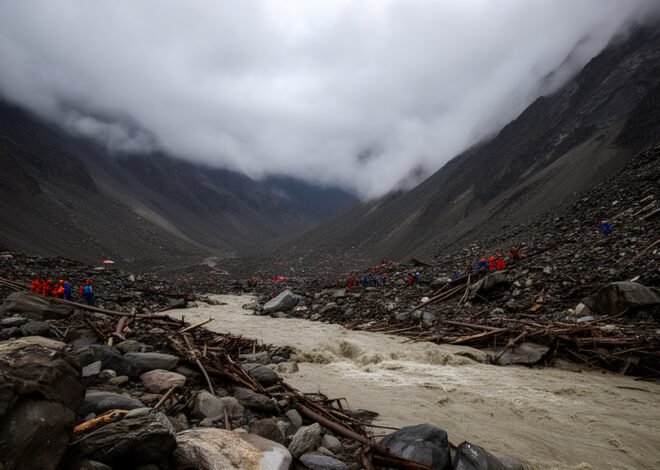
The ongoing disaster along the Nepal-China border has transcended regional emergency response capabilities, creating a humanitarian crisis of unprecedented scale. The confirmed death toll of 500 represents only a fraction of the total human cost, as search operations are hampered by thick mud, unstable riverbanks, and destroyed transport infrastructure. The 1,000 individuals missing are presumed to be trapped in remote, inaccessible valleys, or washed downstream by the force of the initial deluge.
Rescue teams, including specialized military units from both Nepal and China, are reporting “nightmarish” conditions. The combination of high-altitude lethargy and the sheer volume of flood debris—comprising uprooted trees, destroyed housing materials, and mudflows—has effectively severed ground-level communication and supply lines. Helicopters are currently the only reliable method for delivering food, medicine, and emergency medical personnel, yet their operations are frequently grounded by erratic weather patterns common to the monsoon season.
The Science of the Lake Threat: GLOFs
At the heart of the ongoing anxiety is the phenomenon known as Glacial Lake Outburst Floods (GLOFs). As global temperatures rise, the glaciers feeding the high-altitude lakes in this region are retreating, leaving behind massive, unstable pools of water held back only by fragile dams of ice and debris (moraines). The current “new threat” identified by geological experts is a specific lake that has reached a critical water-level capacity.
This lake is currently showing signs of structural instability. If the moraine wall fails, it would release a wall of water and sediment downstream, potentially doubling the current destruction. Unlike traditional rainfall-driven floods, a GLOF occurs with little to no warning, moving with the speed and force of a concrete slurry. This threat has forced officials to order the evacuation of multiple low-lying communities that were previously considered outside the direct danger zone.
Cross-Border Geopolitics and Disaster Management
The disaster has necessitated a rapid synchronization of disaster management protocols between Nepal and China. The border region, characterized by its extreme elevation and rugged geography, has long been a challenge for coordinated environmental monitoring. This event highlights the urgent need for a shared, real-time Early Warning System (EWS) that bridges national divides.
Both nations are currently coordinating data sharing regarding the stability of the aforementioned glacial lake. Without such cooperation, the downstream impacts—which do not respect international borders—would be significantly worse. This disaster serves as a stark case study on why climate-related hazards demand transboundary environmental governance, rather than isolated national strategies.
Economic and Long-term Social Impact
The economic toll of these floods will be felt for years, if not decades. The affected area is primarily agricultural and pastoral, with vital infrastructure including bridge connections, hydroelectric dams, and local roadways completely erased. The loss of livestock, crop land, and homes for 1,000 missing families means that even in the absence of further flooding, the region faces a long road of reconstruction.
Beyond the infrastructure, there is the psychological impact on indigenous mountain communities who have relied on these waterways for generations. The unpredictability of these events is fundamentally altering how communities perceive their land. Many survivors are now facing the reality that their ancestral villages may no longer be habitable, sparking a conversation about the necessity of managed retreat—a complex social policy challenge that authorities will need to address in the coming months.
Future Climate Resilience
This disaster is not an isolated event; it is part of a growing trend of climate-induced catastrophes in the “Third Pole”—a term often used to describe the Hindu Kush Himalaya region. Experts indicate that the intensification of the monsoon, coupled with rapid glacial melt, is creating a new baseline of environmental risk.
Future resilience will require a massive investment in geological monitoring technology, such as satellite-linked sensors that can detect micro-tremors or subtle dam wall erosion in real-time. Additionally, there is a push for “nature-based solutions,” such as the reforestation of riverbanks and the engineering of spillways to manage the water levels of vulnerable glacial lakes proactively. This tragedy, while devastating, provides a grim mandate for regional powers to accelerate their climate adaptation budgets and prioritize the safety of mountain populations over static infrastructure projects.
FAQ: People Also Ask
Q: What is a Glacial Lake Outburst Flood (GLOF) and why is it dangerous?
A: A GLOF is a sudden release of water from a glacial lake. Because these lakes are held by unstable natural dams, they can collapse without warning, unleashing massive torrents of water and debris that destroy everything in their path. They are considered one of the most dangerous, fast-moving flood types in high-mountain regions.
Q: Why is the rescue operation so difficult in this region?
A: The Nepal-China border area features extreme, high-altitude terrain. The rugged mountains make ground transport nearly impossible once roads are washed away, and unpredictable high-altitude weather limits the use of aircraft, forcing rescuers to rely on difficult and slow manual operations.
Q: Are there plans to evacuate residents near the threatened lake?
A: Yes. Authorities have issued emergency evacuation notices for downstream residents. The primary objective is to move individuals to higher, more stable ground to prevent further loss of life should the glacial dam fail.
Q: What caused such massive flooding in this specific area?
A: While the monsoon season provides the heavy rainfall, the severity is amplified by the presence of numerous glacial lakes that are becoming increasingly unstable due to climate change, creating a “force multiplier” effect where rain is compounded by potential dam failures.


Related Posts