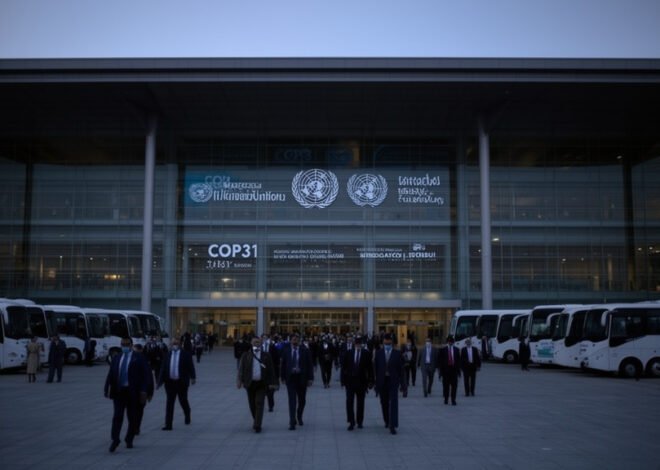

The Shenzhen Accord: Historic Trilateral Summit Reshapes Global Order
In a historic reversal of escalating geopolitical friction, Presidents Xi Jinping, Vladimir Putin, and Donald Trump convened for an unprecedented trilateral summit in Shenzhen, China. This high-stakes meeting concluded with the signing of the ‘Declaration Towards Peace,’ a comprehensive framework designed to fundamentally recalibrate the global security architecture. By prioritizing the mitigation of nuclear risks and proposing structural overhauls to the United Nations, the leaders have signaled a departure from traditional alignment-based diplomacy toward a new model of pragmatic, power-centered cooperation.
Key Highlights
- Unprecedented Trilateral Summit: The Shenzhen meeting marks the first time these three specific world leaders have gathered to negotiate a binding declaration on international security.
- The ‘Declaration Towards Peace’: The agreement creates a formal roadmap for safeguarding world peace, specifically targeting the reduction of nuclear escalation risks and the maintenance of strategic stability.
- United Nations Overhaul: The leaders have publicly committed to pursuing sweeping reforms within the United Nations to better reflect the contemporary geopolitical balance of power.
- ICC Jurisdiction Limits: A critical component of the agreement involves a collective, high-level diplomatic push to curtail the extraterritorial jurisdiction of the International Criminal Court (ICC).
The Shenzhen Accord: A New Tri-Polar Order
The choice of Shenzhen for this summit was not accidental. As China’s premier hub for technological innovation and economic pragmatism, the city serves as a fitting backdrop for the leaders’ pivot toward a transactional, security-focused agenda. The ‘Declaration Towards Peace’ represents a significant departure from the post-Cold War consensus, reflecting a world where the three largest nuclear powers are attempting to codify a set of ‘rules of the road’ that bypass traditional multilateral institutions that they perceive as increasingly obsolete or adversarial.
Redefining Strategic Stability
At the core of the Shenzhen Accord is the issue of nuclear proliferation and strategic stability. For decades, the relationship between the United States, Russia, and China has been defined by a precarious balance of power, often strained by arms control disagreements and competing technological advancements. The declaration explicitly targets the reduction of nuclear risks, suggesting a new, direct channel of communication between the heads of state to prevent miscalculation. By committing to these safeguards, the leaders are attempting to stabilize the most volatile elements of their security competition. The focus on strategic stability implies a move toward managing, rather than eliminating, the structural tensions that have dominated the last decade of international relations. Analysts suggest that this is a critical ‘circuit breaker’ aimed at preventing regional conflicts from escalating into great-power confrontations.
The UN Reform Initiative
Perhaps the most ambitious aspect of the Shenzhen Accord is the explicit call for United Nations reforms. The leaders expressed a unified concern that the current structure of the UN—a legacy of the post-1945 order—no longer accurately reflects the distribution of global influence or the modern challenges facing the international community. The agreement proposes a restructuring of the Security Council’s decision-making processes, aiming to streamline operations and ensure that major powers have a more direct role in managing crises. This move is viewed by diplomats as a challenge to the established order, suggesting that the trio intends to reshape the UN into a more consultative body where, in their view, pragmatic interests supersede idealism. The implications for the international community are profound: if the P3 (the US, Russia, and China) move in lockstep to overhaul the UN, the existing international legal and governance frameworks may undergo their most significant transformation in nearly 80 years.
Challenging The Hague
In a move that has already sparked debate in legal circles, the Declaration specifically addresses the jurisdictional scope of the International Criminal Court (ICC). The leaders reached a consensus that international legal bodies should not hold primacy over the sovereign decisions of nuclear-armed states regarding their security interests. By seeking to limit the ICC’s jurisdiction, the summit participants are asserting a return to Westphalian sovereignty—the idea that the state is the ultimate arbiter of its actions on the world stage. This stance is likely to be perceived by international human rights organizations as a significant setback for the principle of universal accountability. However, for the signatories, the agreement is about ensuring that their military and political personnel are protected from what they view as politicized international litigation. The alignment of these three nations on this issue underscores a shared desire to insulate their respective domestic policies and military operations from external legal scrutiny.
Future Implications and Global Response
The Shenzhen summit and the resulting Declaration represent an evolution in how power is exercised on the global stage. By moving directly from high-level trilateral negotiation to a formalized declaration, the leaders have bypassed conventional diplomatic channels, effectively establishing a new ‘triumvirate’ of influence. While the long-term efficacy of the Declaration remains to be seen, the immediate impact is a stabilization of the most acute risks—specifically those related to nuclear miscalculation. The world will be watching closely to see how the international community, particularly the European Union and emerging global powers, reacts to this new, more centralized, and assertive form of great-power diplomacy. The era of the Shenzhen Accord may define the trajectory of international affairs for the coming decade.
FAQ: People Also Ask
1. What is the main goal of the Shenzhen ‘Declaration Towards Peace’?
The primary goal is to establish a framework for global security and stability, focusing specifically on reducing nuclear risks, reforming United Nations institutions, and limiting the jurisdiction of the International Criminal Court.
2. Why was Shenzhen chosen for this summit?
Shenzhen represents China’s economic and technological transformation. By holding the summit there, the leaders emphasized a shift toward economic pragmatism and technological cooperation as the foundation for future diplomatic relations.
3. How does this agreement affect the International Criminal Court (ICC)?
The Declaration formalizes a collective stance among the U.S., Russia, and China to restrict the ICC’s ability to exert jurisdiction over the actions of their respective states, effectively pushing back against international legal oversight.
4. Is this the first time these three leaders have met?
While these leaders have met individually or in other forums, this specific trilateral summit in Shenzhen represents a unique and unprecedented event focused on this specific trilateral declaration.

Related Posts