
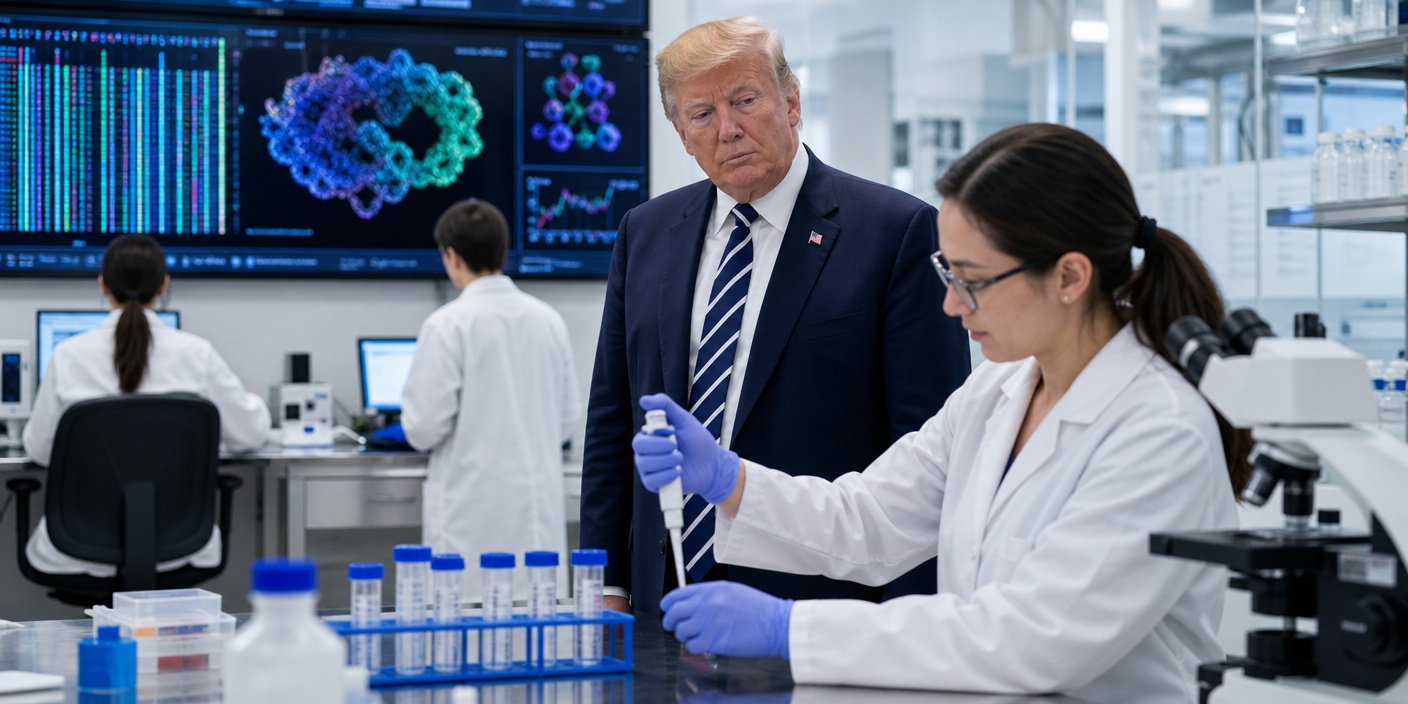
Trump’s $5B ‘Genesis Mission’ Launches: A New Era for AI Science
The Trump administration has officially launched the ‘Genesis Mission,’ a comprehensive, multi-billion-dollar national effort aimed at revolutionizing the trajectory of scientific research through the rapid deployment of artificial intelligence. Backed by a $5 billion investment, this initiative represents a strategic pivot toward leveraging computational power to solve some of the most persistent challenges in modern medicine and biotechnology. By integrating the technical expertise of the White House Office of Science and Technology Policy (OSTP) with the clinical infrastructure of the National Institutes of Health (NIH), the mission seeks to compress the timeline between laboratory discovery and patient application.
Key Highlights
- $5 Billion Investment: A massive federal allocation specifically earmarked for AI-driven scientific research and infrastructure.
- Inter-Agency Collaboration: The mission bridges the NIH and the White House Office of Science and Technology Policy (OSTP) to harmonize policy with practical medical application.
- Core Research Pillars: The initiative prioritizes three critical domains: pediatric cancer treatments, advanced biomanufacturing, and the diagnostic accuracy of chronic diseases.
- Technological Acceleration: Utilizing generative AI and machine learning to analyze massive biological datasets that previously took years to process.
The Genesis Mission: Redefining AI-Driven Scientific Discovery
The Genesis Mission marks a watershed moment in federal science policy, signaling a transition from traditional, manual research methodologies to a high-speed, AI-augmented discovery model. For the past decade, the integration of artificial intelligence into scientific workflows has been sporadic, often siloed within specific university research grants or corporate R&D departments. The Genesis Mission serves as the federal mandate to aggregate these capabilities, providing the resources necessary to scale AI technologies across the national health and science landscape.
Targeting the Frontier of Pediatric Cancer
At the forefront of the Genesis Mission is the fight against pediatric cancer. While oncology has seen significant progress, childhood cancers remain complex due to their rare genetic mutations and diverse clinical presentations. The $5 billion funding package provides the NIH with the computational capacity to deploy AI algorithms capable of cross-referencing thousands of pediatric tumor profiles against global genomic databases. This allows researchers to identify personalized therapeutic targets in days rather than years. By streamlining the patient-to-discovery pipeline, the mission aims to increase survival rates for the most difficult-to-treat childhood malignancies.
Biomanufacturing and the New Industrial Bio-Economy
The scope of the mission extends beyond direct patient care into the infrastructure of the future: biomanufacturing. This component of the Genesis Mission focuses on using AI to optimize the production of biological materials—from synthetic insulin to complex protein therapies and vaccines. By utilizing predictive modeling, the government aims to reduce the overhead costs and environmental impact of large-scale manufacturing. This is not merely a scientific endeavor but an economic one, positioning the United States to lead the global supply chain in high-value biotechnological components. AI will be tasked with identifying the most efficient bioreactor conditions, minimizing waste, and accelerating the production timeline for essential therapeutics.
Transforming Chronic Disease Diagnosis
Perhaps the most immediate impact of the Genesis Mission will be felt in the diagnosis of chronic diseases. From autoimmune disorders to neurodegenerative conditions, early detection is currently the primary barrier to effective treatment. The mission facilitates the development of AI-driven diagnostic tools that can analyze medical imaging, electronic health records, and longitudinal biomarker data with unprecedented precision. By catching chronic illnesses in their sub-clinical phases, the administration aims to shift the national healthcare model from reactionary treatment to preventative maintenance, significantly lowering long-term public health costs.
Policy and Technological Synergy: The NIH-OSTP Partnership
Success in this arena requires more than just capital; it requires a rigid, secure, and interoperable regulatory framework. The partnership between the NIH and the OSTP is designed to solve the ‘policy bottleneck’ often associated with federal tech initiatives. The OSTP provides the technical oversight and regulatory sandboxes necessary to experiment with AI without compromising patient privacy or data integrity, while the NIH provides the raw, anonymized clinical data required to train these advanced models. This dual approach ensures that the $5 billion investment is shielded from bureaucratic red tape and remains focused on tangible, outcome-based research.
Economic Impact and Global Competitiveness
In an era of intensifying global competition, the Genesis Mission is as much about geopolitical strategy as it is about health. By institutionalizing AI in science, the United States is setting a standard for how modern economies should harness computing power for public good. The creation of a dedicated infrastructure for AI science is expected to drive private-sector innovation, attracting top talent and capital to the domestic biotech and AI sectors. This ecosystem approach will likely spawn new startups and spin-off technologies that extend far beyond the original scope of the mission, reinforcing the nation’s position at the helm of the Fourth Industrial Revolution.
FAQ: People Also Ask
Q: What is the primary goal of the Genesis Mission?
A: The primary goal is to leverage a $5 billion investment in artificial intelligence to accelerate scientific breakthroughs, specifically focusing on pediatric cancer treatment, biomanufacturing efficiency, and early detection of chronic diseases.
Q: Who are the key agencies involved?
A: The mission is led by the White House Office of Science and Technology Policy (OSTP) in direct collaboration with the National Institutes of Health (NIH), ensuring a blend of high-level policy guidance and clinical research application.
Q: How does this mission impact the healthcare industry?
A: It aims to transform healthcare from a reactive model to a proactive, preventative one by using AI to identify chronic conditions before they become critical, while simultaneously reducing the cost and time required to manufacture biological therapies.
Q: Is this funding immediate?
A: Yes, the $5 billion investment is the cornerstone of the mission, designed to jump-start infrastructure projects, data sharing initiatives, and research programs immediately upon implementation.


Related Posts