
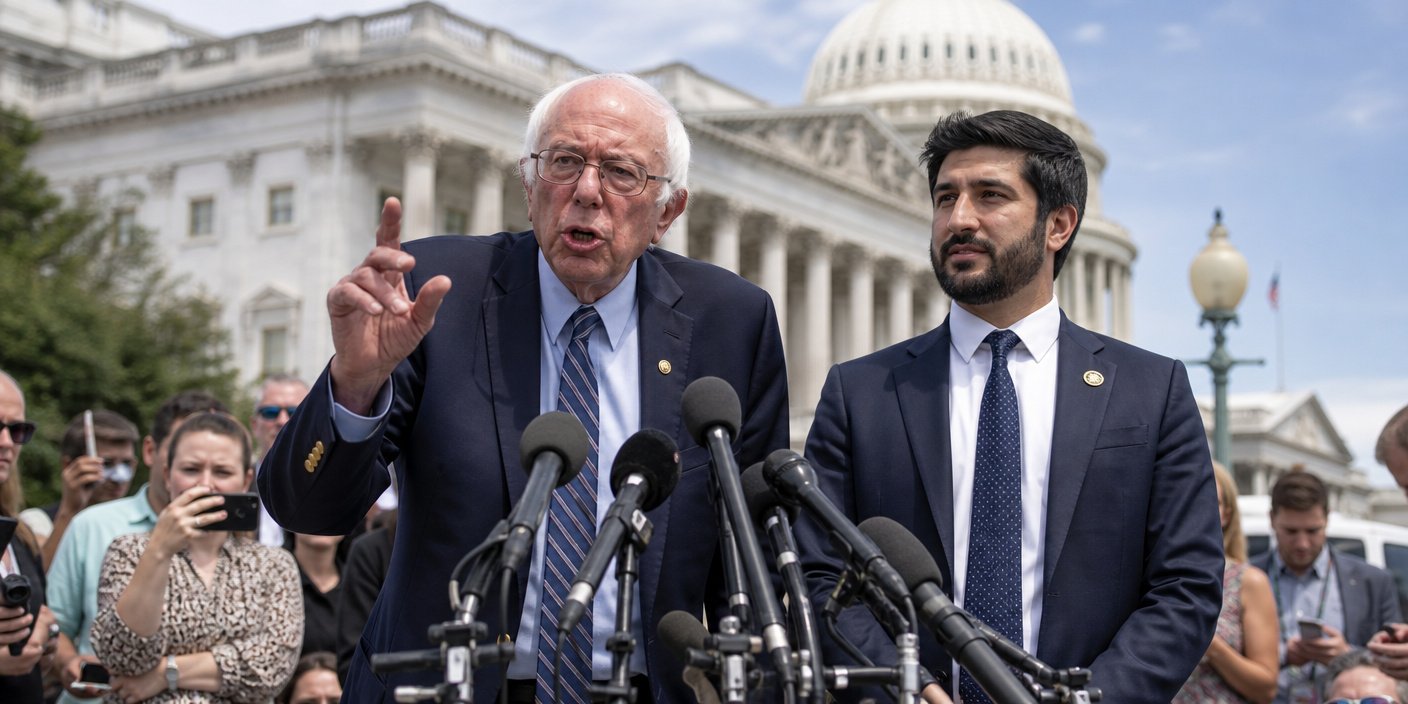
Sanders, Casar Launch Bid to Ban Superintelligence
Senator Bernie Sanders (I-VT) and Representative Greg Casar (D-TX) have formally introduced the “Ban Artificial Superintelligence Act,” a landmark piece of legislation that seeks to fundamentally alter the trajectory of the artificial intelligence industry in the United States. The bill marks one of the most aggressive federal interventions in the history of emerging technology, aiming to restrict the development of artificial intelligence systems that surpass human cognitive capabilities—a threshold often referred to as artificial superintelligence (ASI). Beyond the ban, the legislation mandates the creation of a dedicated, cabinet-level Department of AI Safety, tasked with the rigorous enforcement of these restrictions and the oversight of all large-scale AI research and deployment.
Key Highlights
- Legislative Goal: The ‘Ban Artificial Superintelligence Act’ seeks to legally prohibit the development or deployment of AI systems that demonstrate cognitive capabilities exceeding those of a human being.
- New Cabinet Department: The bill mandates the establishment of a dedicated, cabinet-level Department of AI Safety to centralize federal regulatory oversight.
- Enforcement Mechanisms: Provisions include strict penalties for non-compliance, aiming to curb unchecked scaling laws in big tech.
- Regulatory Scope: The proposed legislation focuses on the boundary between advanced generative AI and potential superintelligence.
The Legislative Frontier: Restricting Superintelligence
The introduction of the Ban Artificial Superintelligence Act represents a critical escalation in the ongoing debate surrounding AI safety. While previous legislative efforts, such as the various AI executive orders and voluntary commitments by tech giants, have focused largely on transparency and bias mitigation, the Sanders-Casar bill adopts a prohibitionist stance. At the core of the legislation is the desire to preemptively address the risks associated with Artificial General Intelligence (AGI) and the subsequent leap to superintelligence—a stage where systems could theoretically out-think human researchers, making them uncontrollable and unpredictable.
Defining the Boundary of Human Cognition
One of the most complex challenges facing the proposed Department of AI Safety will be the technical definition of “superintelligence.” The bill attempts to create a statutory framework that distinguishes between current large language models (LLMs), which the sponsors categorize as sophisticated tools, and systems that exhibit autonomous cognitive reasoning beyond the current human baseline. This distinction is vital, as it seeks to avoid stifling innovation in practical applications—such as drug discovery, climate modeling, and administrative automation—while placing a hard ceiling on research that pursues recursive self-improvement or autonomy that could threaten human agency.
Legislators are tasked with grappling with the “black box” nature of neural networks. Because the internal logic of deep learning models is often opaque, the bill proposes rigorous, auditable testing benchmarks. Companies would be required to submit their models for “cognitive capability stress tests” before they are authorized for public release or scaling, effectively requiring developers to prove that their systems remain within the boundaries of human-equivalent intelligence.
A New Cabinet-Level Department of AI Safety
Central to the enforcement strategy is the creation of a Department of AI Safety. By elevating AI regulation to a cabinet-level position, Sanders and Casar aim to ensure that the agency has the political leverage and budgetary authority to counter the immense lobbying power of major technology conglomerates. This department would be responsible for issuing licenses for high-compute training runs, monitoring the physical infrastructure—such as the rapid acquisition of GPUs—required to train advanced models, and coordinating with international partners to prevent “regulatory arbitrage,” where companies might move operations to jurisdictions with laxer standards.
This departmental structure would likely include specialized divisions for technical auditing, ethical alignment, and rapid response to AI-related security incidents. It represents a pivot from the current fragmented approach, where AI oversight is scattered across the FTC, the Department of Commerce, and various other agencies, each with limited scope and authority.
Economic and Geopolitical Implications
The bill has sparked a significant debate regarding the competitive landscape of the global tech economy. Critics argue that by unilaterally banning superintelligence, the United States risks losing its lead in an “AI arms race” to geopolitical rivals. The counter-argument, championed by proponents of the bill, is that an uncontrolled race toward superintelligence creates existential risks that outweigh any short-term economic gains.
Furthermore, the legislation addresses the economic concentration of power within the industry. By placing strict penalties on non-compliance—which could range from massive fines to the immediate cessation of training operations—the act aims to force companies to prioritize safety over speed. This could lead to a structural shift in how AI companies attract investment; investors may shy away from projects that risk running afoul of the new regulatory limits, potentially slowing down the massive capital expenditure currently fueling the AI boom.
Historical Precedents and Challenges
There is little historical precedent for banning a nascent technology before its full potential has been realized. Comparing the bill to the regulation of nuclear energy, proponents argue that just as society established the Nuclear Regulatory Commission to oversee atomic power, we must now govern intelligence. However, skeptics point to the development of the internet and earlier computing paradigms, noting that government regulation has historically struggled to keep pace with the exponential nature of technological advancement. The primary risk, according to opponents, is that the bill might drive the most advanced research into the shadows or offshore, where it could continue without the safety guardrails the legislation seeks to impose.
Ultimately, the Sanders-Casar bill represents a fundamental questioning of the current tech trajectory. It challenges the assumption that technological progress is inherently beneficial and demands that the government play an active, prohibitive role in defining the future of human-machine interaction.
FAQ: People Also Ask
1. What specifically does the ‘Ban Artificial Superintelligence Act’ prohibit?
The act prohibits the development, training, and deployment of artificial intelligence systems that demonstrate cognitive capabilities exceeding those of human beings, aiming to prevent the emergence of uncontrolled or autonomous superintelligence.
2. How does this bill define ‘superintelligence’?
While technical definitions are still being codified, the legislation relies on benchmarks and testing criteria set by the proposed Department of AI Safety to measure when a model’s reasoning, problem-solving, and adaptability surpass human-level cognition.
3. Will this impact consumer AI tools like ChatGPT or Claude?
Likely not directly. The legislation is targeted at “frontier” models and systems that are designed to exceed human capabilities. Standard productivity tools and existing AI models that remain within human-level cognitive bounds are expected to remain unaffected, though they may face stricter safety and transparency audits.
4. What are the penalties for non-compliance?
The bill outlines strict penalties, including substantial financial fines, mandatory suspension of training runs for non-compliant hardware clusters, and potential legal action against corporate officers who knowingly authorize the development of forbidden superintelligent systems.


Related Posts