
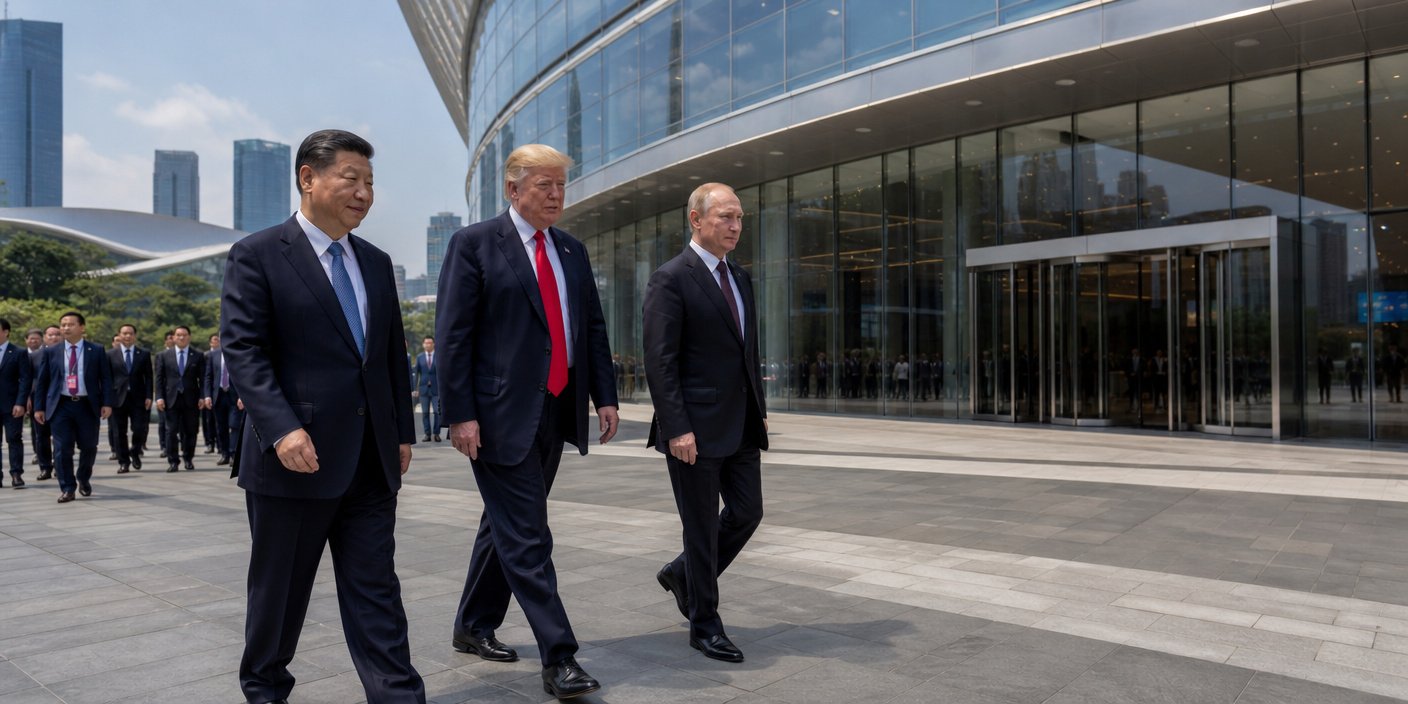
Xi, Trump, Putin Convene: Shenzhen Summit Shakes Global Order
In a display of realpolitik that has caught international observers off guard, Chinese President Xi Jinping is today hosting US President Donald Trump and Russian President Vladimir Putin in the high-tech hub of Shenzhen. This rare three-way summit, occurring just days before the APEC Economic Leaders’ Meeting, signals a potential fundamental restructuring of global alliances. While the leaders seek to de-escalate tensions surrounding nuclear proliferation and contentious trade tariffs, the backdrop is defined by two escalating international crises: the intensification of Iranian-backed attacks in the Gulf and the European Union’s commitment of a massive €45 billion loan package to Ukraine.
Key Highlights
- Trilateral High-Stakes Summit: President Xi Jinping hosts US President Donald Trump and Russian President Vladimir Putin in Shenzhen to negotiate a path forward on nuclear arms reduction and global trade stability.
- Economic Realignments: The discussions in Shenzhen are expected to influence the upcoming APEC agenda, with markets watching closely for shifts in US-China trade policy and Russian energy integration.
- Gulf Escalation: Military tensions have reached a boiling point as Iranian-linked forces expand offensive operations in the Gulf, threatening global shipping lanes.
- EU Financial Commitment: As the geopolitical landscape shifts, the European Union has finalized a €45 billion loan package designed to bolster Ukraine’s defense and economic stability through 2027.
The Shenzhen Pivot: A New Tri-Polar Dynamic
The choice of Shenzhen—the cradle of China’s reform and opening-up policy—as the venue for this summit is deeply symbolic. By bringing Donald Trump and Vladimir Putin to the heart of the Pearl River Delta, Beijing is signaling its desire to act not merely as a participant, but as the architect of a new, tri-polar international order. The objective of the summit is multifaceted, focusing primarily on stabilizing a global economy that has been rattled by fragmentation, and addressing the precarious state of the global nuclear non-proliferation regime.
Negotiating the Nuclear Threshold
At the forefront of the agenda is the precarious status of global nuclear security. With the expansion of nuclear programs in multiple theaters, the three leaders are tasked with drafting a framework that moves beyond the stalemates of the early 2020s. Analysts suggest that the discussion revolves around a new ‘Tri-Lateral Strategic Stability’ agreement. Unlike previous Cold War-era bilateral treaties, this proposal reportedly seeks to include China as an equal stakeholder, balancing US and Russian arsenals against China’s modernized deterrent capabilities. The success of this summit may well hinge on whether the participants can agree to transparency measures that prevent accidental escalation in the South China Sea and Eastern Europe.
Trade Wars and Economic Interdependence
The trade component of the Shenzhen discussions represents a potential thaw in the ‘de-risking’ strategies that have dominated the last three years. Donald Trump, emphasizing his ‘America First’ platform, is looking to secure guaranteed market access and specific manufacturing concessions from Beijing, while Xi Jinping is likely pushing for a relaxation of export controls on semiconductor technology. This negotiation is occurring against the backdrop of the APEC Economic Leaders’ Meeting; leaders are keenly aware that any agreements reached here will set the tone for the regional trade frameworks that will be debated in the coming week. The volatility of the US Dollar and the volatility in energy markets remain the primary pressure points for all three delegations.
The EU’s Strategic Autonomy in Ukraine
While the Shenzhen summit captures the world’s attention, the European Union has made a decisive move that underscores its growing strategic autonomy. The announced €45 billion loan to Ukraine is not just a financial lifeline; it is a geopolitical statement. By bypassing the uncertainty of US domestic legislative bottlenecks, the EU is positioning itself as the primary guarantor of Ukraine’s long-term sovereignty. This move has created a ripple effect in the Shenzhen discussions, with Putin reportedly seeking assurances regarding the long-term deployment of Western assets funded by this package. The EU’s commitment signals that regardless of how the Shenzhen talks proceed, European security interests remain tethered to the containment of conflict in Eastern Europe.
The Gulf Crisis: A Global Security Threat
The final, and perhaps most volatile, item on the periphery of the summit is the expansion of Iranian attacks in the Gulf. This escalation is threatening to disrupt global energy supply chains at a critical juncture. The three leaders are expected to issue a joint statement on maritime security, a rare instance of alignment where all three powers share a vested interest in keeping the Strait of Hormuz open. The challenge, however, lies in whether this shared interest can override the deeper geopolitical rivalries that define the current era. The intensity of these attacks suggests that non-state actors are testing the resolve of major powers, and the Shenzhen summit provides a platform for these powers to signal their limits.
FAQ: People Also Ask
Why was Shenzhen chosen for the summit?
Shenzhen was selected for its symbolic importance as an economic engine. Hosting the US and Russian presidents in China’s tech hub allows Beijing to showcase its manufacturing capabilities and infrastructure, framing the summit as a forward-looking discussion on future global development rather than a retrospective on past conflicts.
How will the €45 billion EU loan affect the war in Ukraine?
The loan provides Ukraine with the liquidity necessary to maintain state functions and continue its defense efforts through 2027. It reduces the country’s dependence on unpredictable foreign aid cycles and signals to Moscow that the European Union is prepared for a long-term commitment to Ukraine’s security.
What are the main risks of the Shenzhen summit?
The primary risk is that the summit fails to produce actionable results, thereby highlighting the depth of the geopolitical divide. There is also the concern that the focus on high-level state diplomacy could alienate smaller nations participating in the APEC meeting, who may feel their interests are being decided by the three ‘superpowers’ without their consultation.
What are the ‘Iranian-backed attacks’ mentioned in the reports?
The reports refer to a series of coordinated maritime and aerial strikes in the Gulf, targeting commercial shipping and regional infrastructure. These attacks have been attributed to proxy forces supported by Iran, serving as a ‘gray-zone’ tactic to pressure Western interests in the Middle East.

Related Posts