Media Blackout: Networks Rally Against White House Access Restrictions
A historic schism between the Fourth Estate and the executive branch reached a breaking point on September 22, as major television networks—including CBS, NBC, ABC, Fox, and CNN—announced a coordinated boycott of White House pool video coverage. This unprecedented action serves as a collective protest against the Trump administration’s move to restrict access for specific journalists, effectively barring CNN, MS NOW, and Politico from essential press pool operations. The standoff arrives at a precarious moment for the administration, as recent polling data confirms that President Trump’s approval ratings have slipped to 32%, a figure that signals growing volatility in his base and broader public opinion.
The Anatomy of the Media-Government Rift
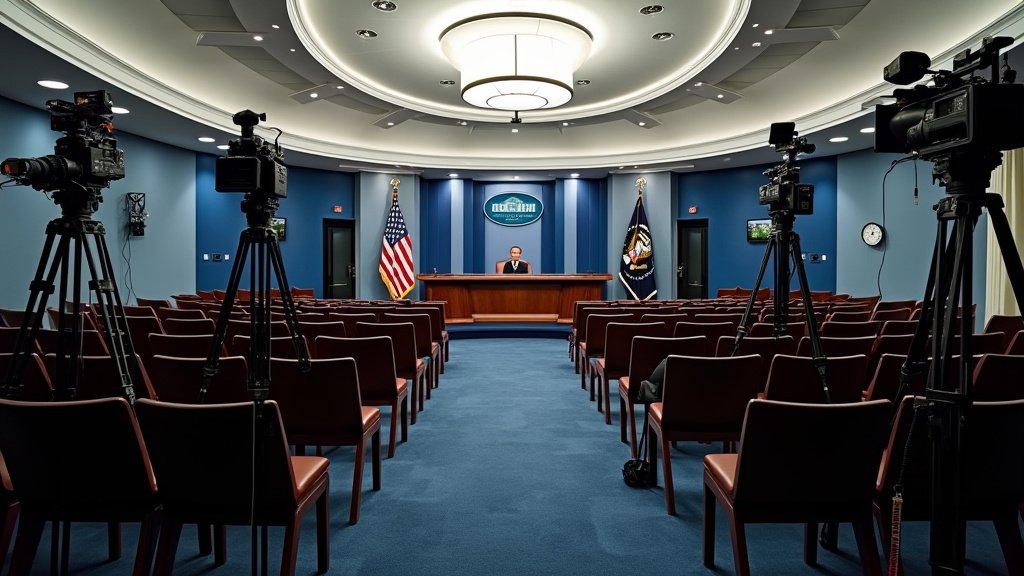
The decision by the major networks to withhold participation in the White House pool feed is a tactical response to the administration’s decision to revoke or deny credentials to specific outlets. In the ecosystem of Washington journalism, the “pool” is the mechanism by which a small group of reporters gathers information and footage to share with the broader industry. By blocking outlets like CNN, MS NOW, and Politico, the administration has disrupted this standard operating procedure. The networks have framed their boycott as a defense of the First Amendment and the necessity of unfettered access for a functioning democracy.
The White House Correspondents’ Association (WHCA) has historically guarded the sanctity of this pool system. By removing specific outlets, the administration is accused of “cherry-picking” the press, a move that critics argue weaponizes access. The networks’ decision to pull the plug on the pool feed—effectively denying the White House its broadcast reach via these traditional conduits—is a high-stakes gamble. It aims to force a reversal of the exclusionary policies by demonstrating that the administration cannot selectively punish outlets while still reaping the benefits of the shared broadcast infrastructure.
Analyzing the 32% Approval Plunge
The timing of this media confrontation is inextricably linked to the administration’s shifting political standing. A national approval rating of 32% places the President at a critical juncture, suggesting that the administration is operating from a position of relative weakness rather than strength. Historically, when presidential approval drops below 40%, the “bully pulpit” loses its efficacy, and the White House becomes more insular. This insularity is often a precursor to stricter controls on messaging, which in turn explains the harder line taken against the press.
Political analysts suggest that the 32% mark is not just a statistical anomaly but a reflection of cumulative fatigue among the electorate. Whether this is driven by economic concerns, foreign policy disputes, or the ongoing internal friction within the executive branch, the number itself limits the President’s ability to drive a legislative agenda. Consequently, the administration’s strategy of banning specific outlets appears to be an attempt to manage the narrative flow in a media environment that is increasingly hostile toward an administration grappling with low approval figures.
The Constitutional Implications of Information Restriction
At the heart of this conflict lies the tension between Executive Privilege and the public’s right to know. The First Amendment protections that undergird American journalism are being tested by the administration’s attempts to filter which entities receive institutional access. If the executive branch is permitted to set a precedent where “unfavorable” coverage justifies the removal of pool credentials, the nature of the White House press corps will fundamentally change. It would shift from a role of oversight to one of invitation-only access, which many argue is incompatible with democratic governance.
Legal scholars have noted that while the White House has broad discretion over its property, the institutional role of the press pool is governed by long-standing customs that equate to a form of “public trust.” By severing these ties, the administration is testing the limits of this trust. The participating networks—ABC, NBC, CBS, Fox, and CNN—are arguing that the pool is not a privilege to be granted or revoked by the President, but a structural necessity for the American people to remain informed.
Economic and Operational Impacts on Networks
For the networks, the cost of this boycott is not insignificant. Producing independent coverage of the White House is far more resource-intensive than relying on a shared pool feed. However, the collective decision to shoulder this cost reflects the gravity of the situation. By forcing the networks to deploy their own cameras and crew for every event, the administration has effectively increased the “price of admission” to report on the President. The networks’ decision to boycott the pool instead suggests that they are willing to bear these logistical burdens rather than participate in a system that they believe has been compromised by political favoritism. This indicates a high level of unity among the networks, an unusual occurrence in the hyper-competitive landscape of cable and broadcast news.
FAQ: People Also Ask
What is a White House press pool?
A White House press pool is a small group of journalists, photographers, and videographers who travel with the President and attend events on behalf of the entire press corps. They share their materials—written reports, photos, and video feeds—with other news organizations that cannot attend the events, ensuring comprehensive coverage of the President’s activities.
Why was the boycott initiated by the major networks?
The networks (CBS, NBC, ABC, Fox, and CNN) initiated the boycott as a collective response to the Trump administration’s decision to exclude CNN, MS NOW, and Politico from the press pool. The networks argue that this action violates the principle of open access and threatens the integrity of independent journalism.
What does a 32% approval rating signify for an administration?
An approval rating of 32% indicates significant public dissatisfaction. In political science, it is considered a “danger zone” that often hinders a President’s ability to pass legislation, unite their party, or effectively communicate their agenda to the public. It frequently leads to more aggressive or defensive media strategies, such as the one currently observed.
How long will this media standoff last?
There is no clear timeline for when the boycott will end. Historically, such standoffs continue until either the White House restores access to the banned outlets or a third-party mediator—often the White House Correspondents’ Association—brokers a compromise that restores the functionality of the press pool.


Related Posts