Xi, Trump Open Direct ‘Guardrails’ at White House Summit
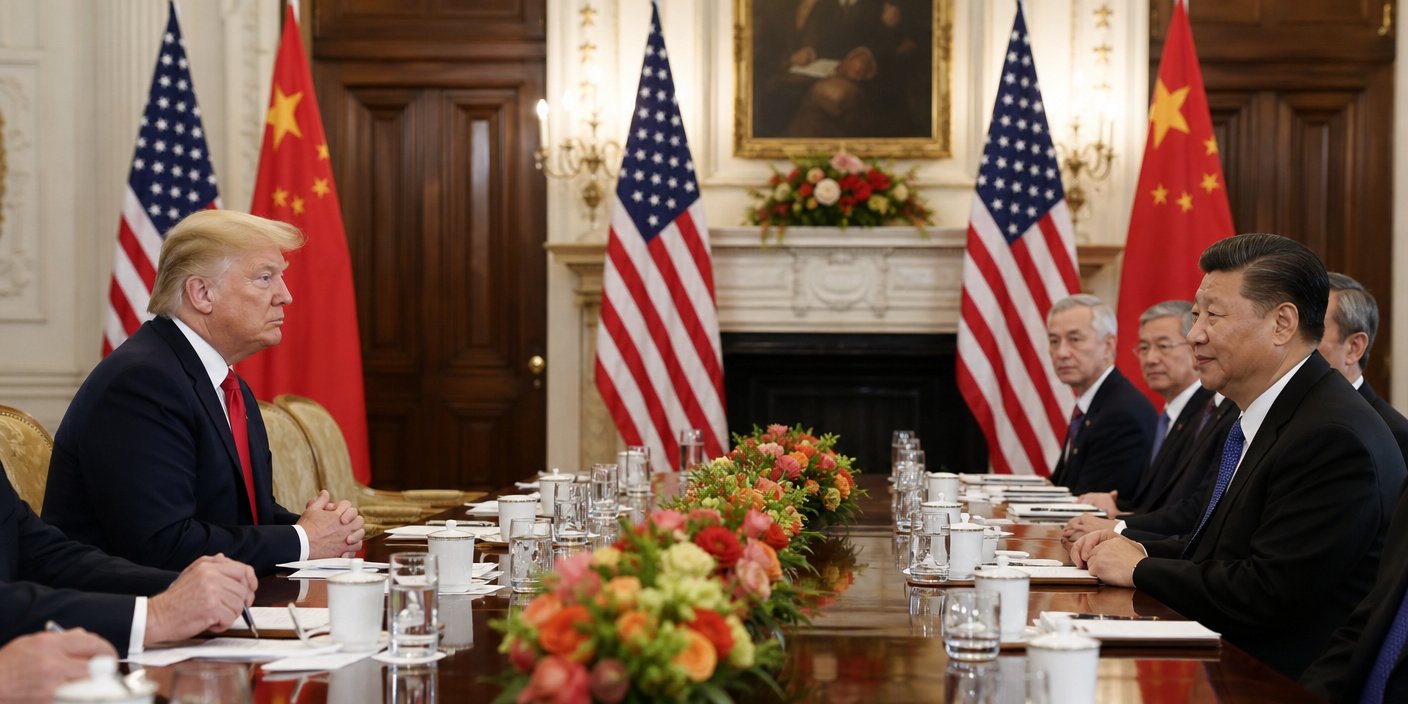
In a decisive diplomatic engagement, Chinese President Xi Jinping and U.S. President Donald Trump convened at the White House to address the rapidly evolving and increasingly volatile trajectory of U.S.-China relations. The summit, centered on the urgent need to establish structural ‘guardrails,’ marked a critical attempt to stabilize a relationship strained by years of technological competition, trade disputes, and geopolitical maneuvering. As both leaders grappled with the implications of the ‘Thucydides trap’—the historical theory that power transitions between a ruling state and a rising power often lead to war—the primary objective of the summit was to delineate clear boundaries to ensure that systemic economic and technological competition does not bleed into kinetic military confrontation.
The Diplomatic Imperative: Escaping the Thucydides Trap
The central theme of the White House discussions revolved around the concept of the ‘Thucydides trap.’ President Xi, framing the concern through a historical lens, argued that the inevitable friction between the United States and China requires proactive management. The concept, popularized by political scientist Graham Allison, suggests that the structural stress caused by a rising power challenging an established hegemon creates an environment where both parties are prone to miscalculation. By explicitly bringing this framework to the negotiation table, Xi sought to shift the bilateral dynamic from a zero-sum game to a managed rivalry.
President Trump and his administration engaged with these proposals, acknowledging that while economic decoupling in specific sectors remains a priority, the risk of mismanaged escalation is unacceptably high. The resulting dialogue focused on institutionalizing communication channels—essentially ‘guardrails’—that would allow both nations to compete in the marketplace and the laboratory without triggering unintended security crises.
Regulating the AI Arms Race
A significant portion of the summit was dedicated to the future of Artificial Intelligence. Both leaders recognized that AI represents a double-edged sword: a driver of immense economic growth and a source of profound existential and military risk. The discussions aimed to establish a preliminary understanding regarding the regulation of AI, particularly concerning its integration into autonomous defense systems. While both nations continue to pursue AI supremacy for national security, the consensus reached during the summit highlights an acknowledgment that unregulated ‘algorithmic escalation’—where AI systems interact in ways humans cannot predict or control—poses a shared risk. This marks one of the first high-level agreements to potentially formalize safety protocols for dual-use technology, moving toward a framework that separates commercial innovation from destabilizing military application.
Geopolitical Flashpoints: Taiwan and Iran
The conversation inevitably pivoted to regional security concerns, specifically the status of Taiwan and the current diplomatic landscape regarding Iran. Addressing Taiwan, both sides reiterated their known red lines, yet the atmosphere suggested a focus on crisis management rather than escalation. By creating clear ‘guardrails,’ the leaders aim to ensure that bureaucratic misunderstandings or local incidents do not escalate into a direct confrontation.
Similarly, the dialogue surrounding Iran focused on the shared interest in maintaining stability in the Middle East, particularly regarding trade routes and energy security. While the strategic goals of Washington and Beijing in the region remain divergent, the agreement to maintain an open line of communication on these topics serves as a vital release valve, preventing localized regional tensions from becoming a proxy for broader U.S.-China instability.
Secondary Angles: Economic Resilience and Long-Term Stability
Beyond the headline-grabbing summits, the economic implications of these ‘guardrails’ are profound. If implemented, these agreements could provide the necessary certainty for global supply chains. For businesses and investors caught in the middle of trade wars, the prospect of ‘managed competition’ offers a glimmer of predictability.
1. Economic Interdependence: The summit underscored that despite talk of decoupling, the U.S. and Chinese economies remain deeply intertwined. The ‘guardrails’ may eventually facilitate a more stable, albeit regulated, trade environment.
2. The Future of Diplomacy: This meeting represents a pivot from the reactive diplomacy of the past decade to a more deliberate, structural approach, signaling a shift in how superpowers manage 21st-century friction.
3. Institutionalizing Trust: The true test of these guardrails will be whether they can survive the domestic political pressures within both nations, a challenge that remains the greatest barrier to long-term bilateral stability.
FAQ: People Also Ask
What does the term ‘guardrails’ mean in the context of US-China relations?
In this diplomatic context, ‘guardrails’ refer to a set of agreed-upon rules, communication channels, and boundary protocols designed to prevent geopolitical and economic competition from escalating into an unintended military conflict or a full-scale trade war.
What is the ‘Thucydides trap’ mentioned by President Xi?
The ‘Thucydides trap’ is a political theory suggesting that when a rising power (like China) threatens to displace an established ruling power (like the U.S.), the structural stress frequently results in war. President Xi used this concept to stress the importance of proactive, peaceful conflict resolution.
Why was AI regulation a key topic at the White House?
AI regulation is a priority because both nations are heavily investing in AI for defense and economic purposes. The leaders discussed establishing shared safety protocols to prevent autonomous systems from escalating conflicts or posing unpredictable global risks, separating commercial development from military utility.
What was the outcome regarding Taiwan and Iran?
The summit focused on establishing clear communication lines and identifying ‘red lines’ for both nations regarding Taiwan and Iran, aiming to manage localized tensions before they spiral into a broader international confrontation.


Related Posts